 BETA
Person
Tawaraya Sotatsu
?–1642 · Pioneering painter of the Rinpa school · Edo Shogunate
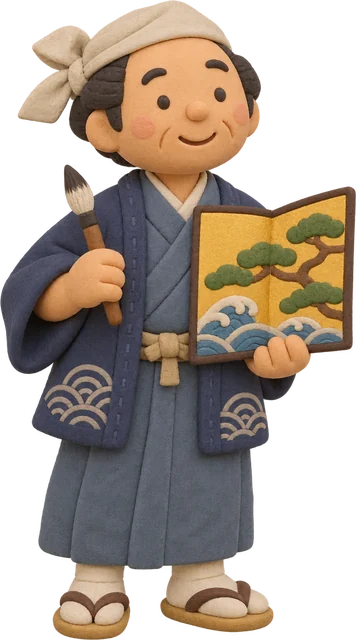
A painter who led a painting workshop in Kyoto. His 1602 repair and decoration of the Heike Nōkyō (Heike sutra offerings) is thought to be an early work, he held the title Hokkyō around 1630, and he is famous for the Wind God and Thunder God screens.
How did a painter who started by selling fan paintings come to stand before the emperor? Sōtatsu was the master of a painting studio in Kyoto. He took part in repairing the Heike Nōkyō and became a Hokkyō. The Wind God and Thunder God screens are his best-known work. A craftsman who had been forgotten was valued again.
More detail
Two sources checked
How did a painter who began by selling fan paintings come to stand before an emperor? The year of Tawaraya Sotatsu's birth is unknown. He is said to have run a Kyoto painting workshop called "Tawaraya" and painted fans and decorative pictures.
It is said that in 1602, when the Heike Nokyo (sutra scrolls dedicated to the Itsukushima Shrine in Hiroshima) were repaired, he took part in painting the covers and the inner pages. A record says that in 1616 Emperor Go-Mizunoo showed Sotatsu's work to painters of the Kano school and told them to use it as a reference. This means that even the famous Kano school looked to his skill.
In 1621 he painted the sliding-door paintings of Yogen-in in Kyoto, and in 1630 he received the high rank of "Hokkyo," which was rare for a painter from a townsperson background. On gold leaf he used bold lines and spreading ink to catch the eye powerfully. It is similar to putting one name on a work made together by students in a handicraft studio.
His best-known works, such as the folding screen of the Wind God and Thunder God, depict the gods of wind and thunder with humor and force. He seems to have died around 1642, and his pupil Soetsu took over the workshop.
Sotatsu's beauty was passed on a hundred years later to Ogata Korin, and a memorial exhibition held in 1913 brought him fresh attention once more. It is the story of a craftsman whose name was fading but who now holds an important place in art history.
Life timeline
- 1602Took part in repairing the Heike Nokyo
- 1616His work was shown before the emperor
- 1621Painted the sliding-door paintings of Yogen-in
- 1630Received the rank of Hokkyo
- 1642Believed to have died around this time
- 1913A memorial exhibition was held and he was re-evaluated
This was about 270 years after his death.