 BETA
Person
Terauchi Masatake
1852–1919 · Field Marshal, First Governor-General of Korea, and Prime Minister · Empire of Japan
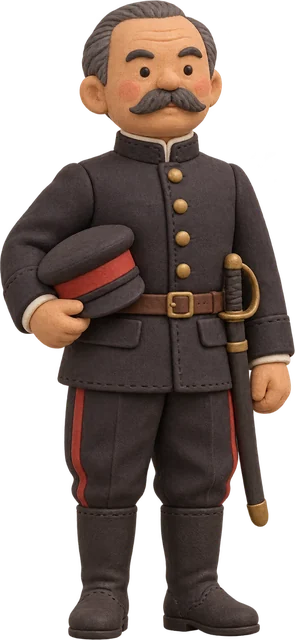
Terauchi Masatake, an army officer from Choshu, completed the annexation of Korea in 1910 as Resident-General of Korea and became the first Governor-General of Korea. As prime minister he resigned in 1918 because of the Siberian Intervention and the Rice Riots.
Who was the person who got the final seal on the papers that closed a country's door? Terauchi Masatake completed the annexation of Korea in 1910 and became the first Governor-General of Korea. After he became prime minister, the Rice Riots broke out and he resigned. Rule held down by force brought strong resistance, such as the March 1st Movement.
More detail
Two sources checked
When a country closed its door in front of guns and swords, who received that final signature? Terauchi Masatake was born in 1852 in the Choshu domain, grew up in the army, and served long as army minister, modernizing the military.
In May 1910 he became the third Resident-General of Korea while remaining army minister, and in August of the same year he led the Korea annexation treaty. It was carried out while the Japanese army had increased its troops in Seoul and blocked newspapers and assemblies. He soon became the first Governor-General of Korea and began a military-style rule in which the military police also did police work. The land survey project also began then, and it became an occasion for many Korean farmers to lose their land.
In 1916 he became prime minister, and when the Russian Revolution broke out he decided on the Siberian Intervention in 1918. But just before this dispatch, rice prices soared, and "rice riots" broke out across the country. Housewives and workers angry at prices attacked rice shops, and even the army was mobilized. In the end the Terauchi cabinet resigned en masse.
In Korea he is remembered as the colonial ruler who completed the annexation, and in Japan as a politician who led military modernization. That the same person is judged so differently shows the distance between how the two countries look at history.
The military-style rule he left behind brought the fierce resistance of the March First Movement in 1919, and Japan had to change its method of rule. It is a lesson that what is held down by force cannot last long.
Life timeline
- 1885Grew up as an army officer
- 1902Became army minister
He held the post for many years. - 1910Became Resident-General of Korea; annexation of Korea
He became the first Governor-General of Korea. - 1916Became prime minister
- 1918Decided on the Siberian Intervention; resigned after the rice riots
- 1919Died