 BETA
Person
Tsukushi no Kimi Iwai
?–528 CE · Powerful clan chief of northern Kyushu · Wa (Yamato Court)
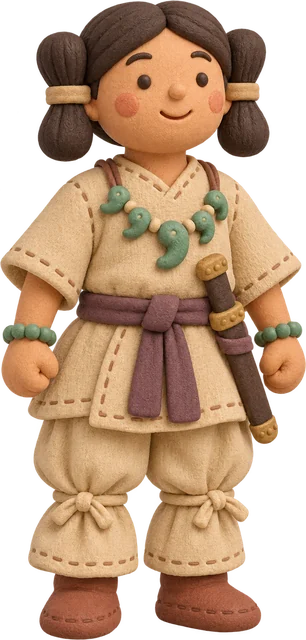
He was a powerful Kyushu clan chief who is said to have joined hands with Silla in 527 and blocked the Yamato Court from sending troops to the Korean peninsula. He was defeated the next year by Mononobe no Arakahi, and stone human figures and stone horses remain at Iwatoyama Kofun, which seems to be his tomb.
A local chief once stood in the way of the king's army. In 527 Iwai of Kyushu joined hands with Silla and stopped the Yamato Court's army from going to the Korean peninsula, but he lost the battle the next year. At Iwatoyama Kofun, thought to be his tomb, stone-carved people and horses still remain. His story makes us think about local stories too, not only the records of the center.
More detail
Two sources checked
What was a provincial chieftain thinking when he blocked the king's army? Iwai was the most powerful chief who ruled the Tsukushi region of northern Kyushu in the early 6th century. According to the Nihon Shoki, in 527, when the Yamato court tried to send an army led by Omi no Kena to help Imna on the Korean Peninsula, Iwai joined hands with Silla and blocked it.
From his point of view, Kyushu was the gateway to the Korean Peninsula. For a Yamato army to pass through Kyushu, it would have had to be given people, ships and food. The record says Silla bribed Iwai, but this may carry the view of the winners. In today's terms, it may be close to a scene in a group project where one kid stood firm and said, "I don't like our neighborhood's resources being used like this."
The court did not take this fight lightly. It sent Mononobe no Arakahi as commander, and in November 528 a great battle took place in the Mii district of Tsukushi. Iwai was killed in that battle, and his son Kuzuko is said to have offered the Kasuya miyake to atone for his father's crime and was spared execution. It became an occasion for Yamato to take a firm grip on Kyushu.
The Iwatoyama Kofun in Yame, Fukuoka Prefecture, is regarded as Iwai's tomb. It is about 135 m long and more than 100 stone figures of people and horses came out of it. Unlike haniwa baked from clay, these figures were carved from stone and are large, and there is an interpretation that they show the pride of a chieftain who stood against Yamato. The Chikugo no Kuni Fudoki also has a story that pursuing soldiers broke the stone statues.
Whether to see Iwai only as a traitor or as a person who tried to protect his region's independence is still debated. That we cannot know the voices of the provinces from the central records alone, and that faces carved in stone speak for the heart of that age, mean something to us today too.
Life timeline
- 527 CEBlocked the army Yamato sent
The Nihon Shoki says he joined hands with Silla. - 528 CEDefeated and killed in the Battle of the Mii district
Mononobe no Arakahi led the army. - 528 CEHis son Kuzuko offered the Kasuya miyake
It is said to have been meant to atone for his father's crime. - 530 CEStone figures of people and horses at the Iwatoyama Kofun
Thought to have been made in the first half of the 6th century. The year is approximate. - 531 CEEmperor Keitai died
After the war Yamato took a firm grip on Kyushu. The year is approximate.