 BETA
Person
Yokoyama Taikan
1868–1958 · Japanese-Style Painter · Empire of Japan
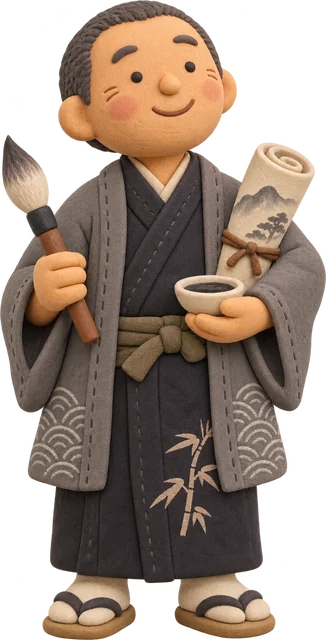
Yokoyama Taikan, from Mito, followed Okakura Tenshin and in 1898 helped found the Japan Art Institute (Nihon Bijutsuin). He tried a new kind of Japanese-style painting with blurred outlines, and in 1937 he received the first Order of Culture.
Is a painting without outlines still a painting? Yokoyama Taikan, together with Okakura Tenshin, tried a new kind of Japanese-style painting with blurred outlines. At first people made fun of it, but he walked a long road and made his own way, and in 1937 he received the first Order of Culture.
More detail
Two sources checked
Is a painting without outlines still a painting? Yokoyama Taikan was born in 1868 in a samurai house in Mito (today's Ibaraki Prefecture). In 1889 he became one of the first students to enter the Tokyo School of Fine Arts, studied under Okakura Tenshin, and graduated in 1893.
Tenshin sought to renew traditional Japanese painting, and Taikan took up that aim. In 1898, when Tenshin was driven out by a movement to oust the principal, Taikan too left the school and took part in founding the Nihon Bijutsuin (Japan Art Institute). He tried reducing ink lines (outlines) and painting in a blurring way, as if seeing through mist. People mocked this as 'moroutai' (the hazy style). It is said there was a period when it was hard to sell his work and he was in great financial trouble.
In 1903-04 he toured India, the United States, and Europe exhibiting, and was first appreciated abroad. In 1914, together with Shimomura Kanzan and others, he revived the Nihon Bijutsuin and became a central figure. His representative works include Kutsugen (Qu Yuan, 1898) and the long handscroll Seisei Ruten (1923).
He received the first Order of Culture in 1937 and left many landscape paintings, including of Mount Fuji. He died in 1958 at the age of ninety. There is also criticism that during the war he took part in events that cooperated with the military.
His paintings show that even if a new method is mocked at first, walking steadily can turn it into a road.
Life timeline
- 1889Enters the Tokyo School of Fine Arts
- 1898Takes part in founding the Nihon Bijutsuin
- 1903Exhibition tour of India, the United States, and Europe
This was in 1903-04. - 1914Revival of the Nihon Bijutsuin
- 1937Receives the first Order of Culture
- 1958Dies