 BETA
Person
Emperor Yuryaku
active 457–479 CE · 21st emperor; the great king regarded as "King Bu" of Wa · Wa (Yamato Court)
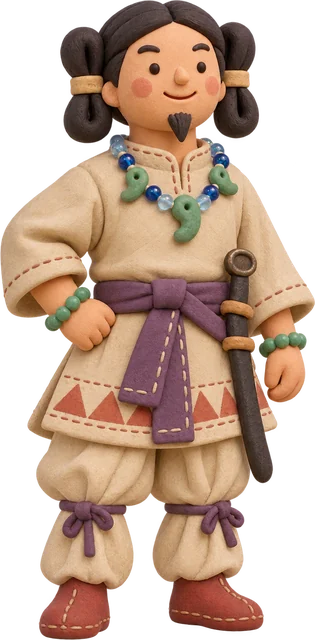
In the late 5th century, Great King Wakatakeru put down powerful clans and strengthened royal power. He is linked to the inscriptions on iron swords and to "King Bu of Wa" in a 478 memorial to the Song court, but the dates and events in the Nihon Shoki are hard to take at face value.
Can writing on a sword tell us a king's name? In the late 5th century, Emperor Yuryaku, called Great King Wakatakeru, is said to have put down powerful clans and strengthened royal power. The same name is carved on swords from Inariyama and Eta Funayama, and it also connects to "King Bu of Wa," who sent a letter to the Song court in 478. This shows how a single artifact today can serve as evidence confirming an old story.
More detail
Two sources checked
Can a single inscribed line on a sword call up a king's name after fifteen hundred years? On the iron sword from the Inariyama Kofun in Saitama Prefecture there are characters meaning "Great King Wakatakeru," and a similar name can be read on the large sword from the Eta Funayama Kofun in Kumamoto Prefecture. Scholars often identify this great king with the 21st emperor of the Nihon Shoki, Emperor Yuryaku, that is, Ohatsuse no Wakatakeru.
In the records Yuryaku is portrayed as a king with a rough temper and quick decisions. It is said that when taking the throne he got rid of rival royals and brothers, and that he tried to build up the king's power by pressing down strong clans. The families that served at his side were the Otomo and the Mononobe, and the high posts called omi and muraji are said to have been created around this time. In today's terms it is like the strongest kid in a group project trying to take the lead. But this account was arranged by the court in later times, so exaggeration may be mixed in.
He is said to have actively taken in the skills of people from across the sea. People who came from the Korean Peninsula passed on skills such as silk weaving and making ironware and pottery, and the Yamato kingship grew with that power. The Chinese history book Song Shu has a letter that the "King Bu of Wa" sent to the Song emperor in 478. It appeals that his ancestors had pacified lands to the east and west and that Goguryeo was blocking the road, and it asks for a general's title. Identifying this King Bu of Wa as Yuryaku is the most widely accepted view now.
Yuryaku is also said to be the king who composed the song at the opening of the Man'yoshu. It is a gentle song asking a girl picking greens for her name, but it may in fact be that his name was attached to it in later times. His tomb is set as the Tajihi no Takawashi no Hara mausoleum in Habikino, Osaka Prefecture.
Yuryaku is a king who left his name through a sword and a letter. In an age when writing was rare, the fact that two inscribed swords speak the same name shows that today a single relic can test and support what a history book says.
Life timeline
- 457 CESaid to have taken the throne
An estimate following Nihon Shoki dating; the exact year differs by theory. - 470 CEPressed down the clans and built up royal power
He is said to have relied on the Otomo and Mononobe. - 471 CE"Great King Wakatakeru" on the Inariyama iron sword
The view that the inscribed date "Shingai year" is 471 is widely accepted. - 478 CE"King Bu of Wa" who sent a letter to the Song court
A letter recorded in the Song Shu; many see him as Yuryaku. - 479 CESaid to have died
The length of his reign differs by record.