 BETA
EventPrehistory and Gojoseon
Development of Paleolithic Culture and the Hand Axes of Jeongok-ri, Yeoncheon
700,000–10,000 BCE (estimated) · Korea · Jeongok-ri, Hantan River basin
Today: Jeongok-ri, Jeongok-eup, Yeoncheon, Gyeonggi Province
In the Paleolithic Age, when people began to live on the Korean Peninsula, the first Acheulean-type hand axes in East Asia were found at Jeongok-ri.
What happened
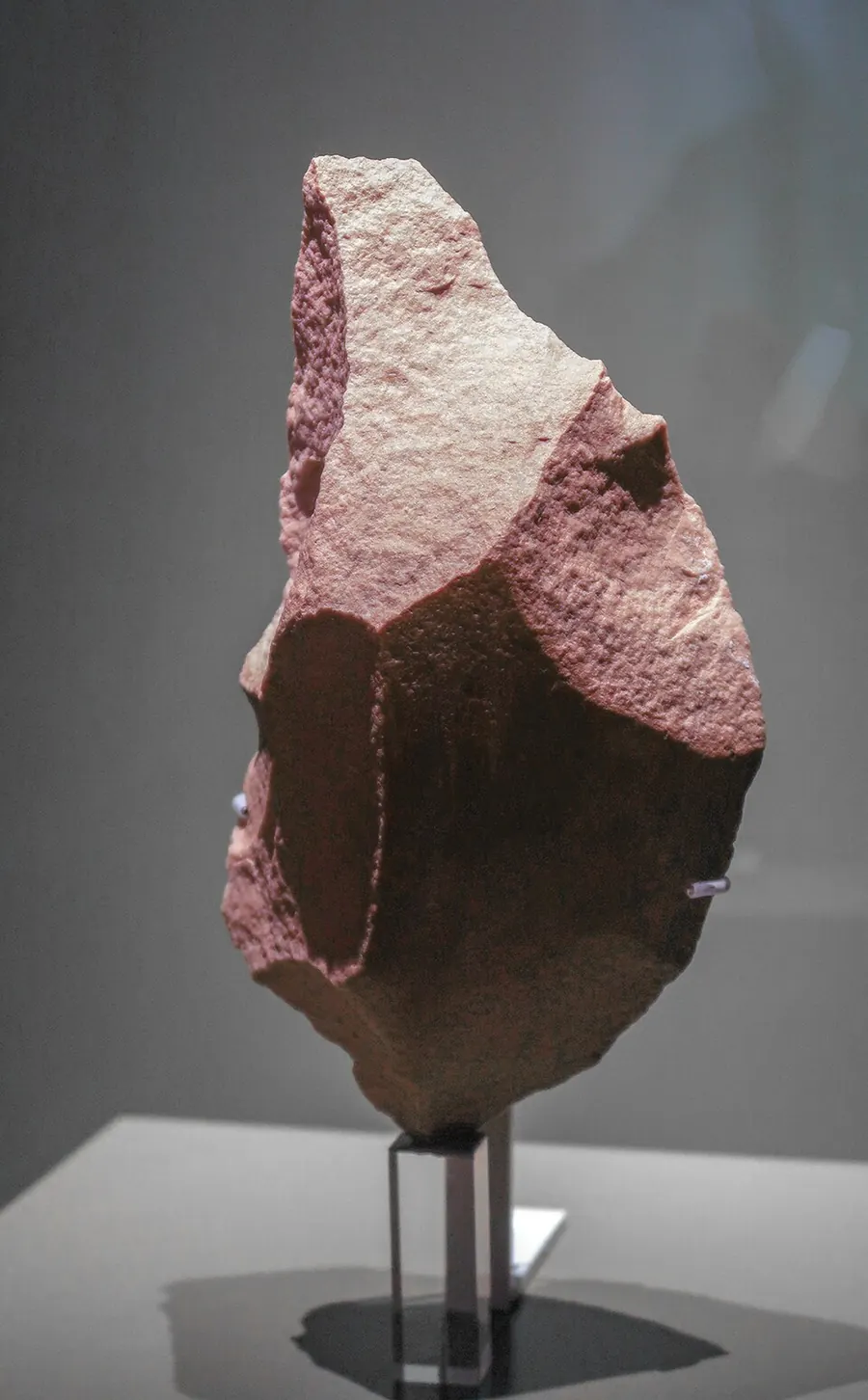
Long, long ago, people are thought to have lived on the Korean Peninsula from about 700,000 years ago. These people hunted and gathered nuts and fruit with tools made by breaking stones. In 1978, an American soldier picked up a stone axe with both sides shaped at Jeongok-ri in Yeoncheon. This hand axe changed the idea that 'there are no axes like this in East Asia.'
More detail
Two sources checked
Why it happened
People have lived on the Korean Peninsula since very long ago. Textbooks put the beginning at about 700,000 years ago. At that time people hunted animals with chipped stone tools made by breaking stones, and gathered tree fruits and roots to eat.
In 1978, Greg Bowen, a US soldier stationed in Dongducheon, was walking along the Hantan River in Yeoncheon when he picked up a few stones of unusual shape. Having once studied archaeology, he showed the stones to Professor Kim Won-yong of Seoul National University for evaluation.
What happened
The stones were hand axes, trimmed on both faces and shaped to a point at the tip. This shape is called the 'Acheulean type,' after the Saint-Acheul area of France where it was first identified.
The site was designated a historic site in 1979, and afterward several universities and national research institutions dug the ground together and continued surveys. Thousands of stone tools have come out so far, and the Jeongokri Prehistory Museum was built next to the site.
What came of it
Until then, in world scholarship, the idea based on a line drawn by the American scholar Movius, that 'Acheulean hand axes exist only in Europe and Africa and not in East Asia,' was widely held.
The Jeongok-ri hand axes were the first Acheulean-type hand axes confirmed in East Asia, so they led people to reconsider this idea. The Paleolithic period on the Korean Peninsula continued until about 10,000 years ago, when the Ice Age was ending.
Links with other countries
They are compared with the Acheulean hand axe tradition of Africa and Europe. They became an occasion for revising the 'Movius Line' theory of Movius of Harvard University in the United States.