 BETA
Person
Gwak Jae-u
1552–1617 · A righteous army leader in the Imjin War · Joseon
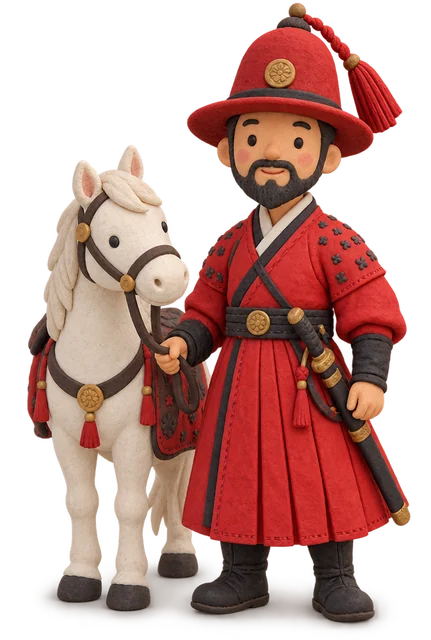
The 'Red-Robed General' who was the first to raise a righteous army in the Imjin War.
When the Imjin War broke out, Gwak Jae-u was the first to raise a righteous army, in Uiryeong, Gyeongsang Province. A righteous army (uibyeong) is an army that the people gathered on their own to protect the country. He fought in red clothes and was called the 'Red-Robed General.' Along the Nakdong River, he blocked the Japanese army's way to Jeolla Province.
More detail
Two sources checked
Gwak Jae-u was born in 1552 in Uiryeong, Gyeongsang Province. He studied under the scholar Jo Sik and was interested not only in Confucian books but also in astronomy, geography and martial arts. In 1585 he was selected in the civil examination, but when his answer was not to the king's liking and his pass was cancelled, he gave up on office and lived in his hometown.
In April 1592, when the Imjin War broke out and government armies collapsed one after another, on the 22nd of that month he raised a righteous army (uibyeong, an army that people gathered by themselves to defend the country) in his hometown. When he spent his own fortune to look after the soldiers and even their families, the righteous army, at first a few dozen, grew to more than a thousand.
He fought wearing red clothes and calling himself the 'Red-Robed General Who Descended from Heaven' (Cheongang Hongui Janggun). Knowing the geography around the Nakdong and Nam Rivers well, he used tactics such as hiding and attacking suddenly, or confusing the enemy with fake troops. At Jeongamjin (Sotbawi Ferry) he drove off Japanese troops who were trying to cross the river, protecting western Gyeongsang Province and blocking the Japanese army's road to Jeolla Province. Thanks to this, farmers in that region could keep farming even during the war.
In the Jeongyu War of 1597 he defended Hwawangsanseong Fortress in Changnyeong and kept the Japanese army from approaching. After the war he was offered high posts several times but declined most of them, built a house called Mangujeong by the river and lived quietly until he died in 1617.
Life timeline
- 1585His examination pass was cancelled
The reason was that his answer did not suit the king's wishes. - 1592Raised a righteous army in Uiryeong
- 1593Became Seongju magistrate
He prepared defenses by repairing the mountain fortress. - 1597Defended Hwawangsanseong Fortress