
Person
Hyecho
active 723–780 CE · A traveling monk of Silla · Unified Silla
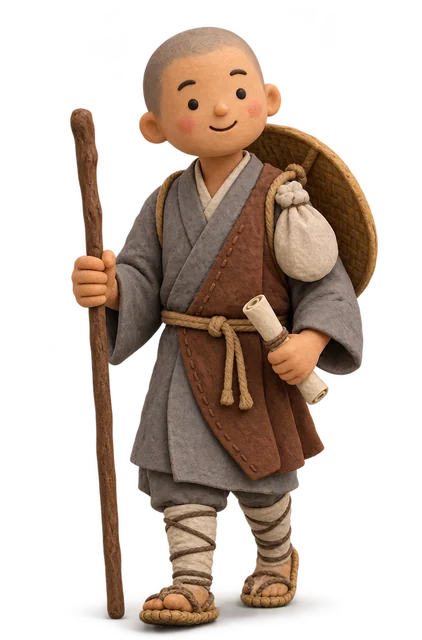
A Silla monk who traveled through India and Central Asia and left the Wang Ocheonchukguk Jeon
Hyecho was a monk of Silla. In the 720s he set out for India and traveled for about four years to the sites of the Buddha's life and to many countries of Central Asia. Some say the year he left was around 723, and others say around 730. He left what he saw and heard in a book called the Wang Ocheonchukguk Jeon (the Memoir of the Pilgrimage to the Five Indian Kingdoms), which shows us what many countries of Asia were like at that time.
More detail
Two sources checked
Hyecho was a monk born in Silla who crossed to Tang China while still young. In Tang he studied esoteric Buddhism (Buddhism that stresses secret rituals) under the monk Vajrabodhi (Geumgangji).
Around 723 Hyecho set out for India, where traces of the Buddha remain. It is not certain whether he went by sea or by land. He visited in turn places such as Varanasi, where the Buddha first taught, Bodh Gaya, where he gained enlightenment, and Kushinagar, where he died. He then passed through present-day Pakistan, Kashmir and Afghanistan and traveled as far as Central Asia.
After a long journey of about four years, in November 727 he arrived at Kucha, where Tang's Anxi Protectorate was located. The travelogue he left, the Wang Ocheonchukguk Jeon (Memoir of the Pilgrimage to the Five Indian Kingdoms), means 'a record written after traveling to the five Indian kingdoms.' It is counted as a unique record in the world of the clothing, food, customs and religion of the people of India and Central Asia in the eighth century.
After returning, Hyecho helped in Chang'an under the monks Vajrabodhi and Amoghavajra with the work of translating Buddhist scriptures into Chinese. In 780 he moved to Mount Wutai, and there is no trace of his having returned to Silla.
The Wang Ocheonchukguk Jeon was forgotten for a long time, until in 1908 the French explorer Pelliot found it in the Thousand Buddha Caves at Dunhuang, China, as a scroll with its beginning and end missing.
Life timeline
- 727 CEFinished his Indian journey and arrived at Kucha
Kucha was where Tang's Anxi Protectorate was located. - 733 CEReceived teaching from Vajrabodhi at Jianfusi Temple in Chang'an
- 780 CEMoved to Mount Wutai in Tang