 BETA
Person
King Jinheung
?–576 CE · A conquering king of Silla · Silla
Birth name: Kim Sammaekjong (金彡麥宗)
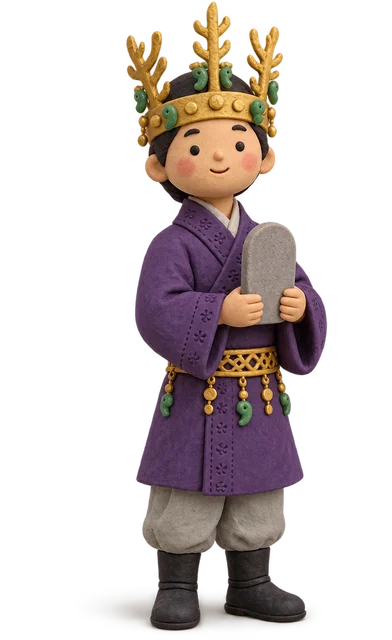
The Silla king who took the Han River area and greatly expanded the territory, laying the stepping stone to unification.
King Jinheung became king of Silla at a young age. He took the land around the Han River and conquered Daegaya in 562. He toured the land he had expanded and set up memorial steles in many places. It was also in this king's time that the Hwarang (a youth warrior corps) was made into a state organization.
More detail
Two sources checked
King Jinheung was the 24th king of Silla and ruled for 37 years, from 540 to 576. He became king at a very young age, and at first his mother, Queen Dowager Jiso, looked after the country on his behalf.
As an adult, King Jinheung worked to expand territory. In 551 he attacked Goguryeo together with King Seong of Baekje and gained the upper Han River, and in 553 he also took the lower Han River that Baekje had held and set up an administrative district called Sinju. When an angered Baekje attacked, he won a great victory in 554 at the Battle of Gwansanseong (present-day Okcheon, North Chungcheong Province), where King Seong was killed. In 562 he conquered Dae Gaya, making even the Gaya lands west of the Nakdong River part of Silla.
Seizing the Han River was extremely important. It gave Silla the fertile land and river routes in the middle of the Korean Peninsula. It is said that through these conquests Silla's territory became about three times larger than before.
King Jinheung also strengthened the country within. In 545 he had Geochilbu and others write the national history Guksa, and he greatly promoted Buddhism, including building Hwangnyongsa Temple. He made the Hwarang, a youth association, into an organization for raising talented people for the country, and he also valued the gayageum music of Ureuk, who had come from Gaya.
King Jinheung toured the newly gained lands and left monuments at Changnyeong, Bukhansan, Hwangchoryeong and Maunryeong. The inspection monument that stood on Bibong peak of Bukhansan in Seoul can now be seen at the National Museum of Korea.
Life timeline
- 540 CEBecame king
- 545 CEOrdered the compilation of Guksa
- 551 CETook the upper Han River
He changed the reign name to 'Gaeguk.' - 553 CETook the lower Han River and set up Sinju
- 554 CEWon the Battle of Gwansanseong
- 561 CEErected the Changnyeong monument
- 562 CEConquered Dae Gaya
- 568 CEErected the Hwangchoryeong and Maunryeong monuments
- 576 CEDied
Related events
- 42 CERise and Fall of the Gaya Confederacy
- 433 CEThe Silla-Baekje Alliance (Naje Alliance)
- 540 CEThe Hwarangdo Becomes a State Organization
- 545 CEGeochilbu Writes Silla's History Book, the Guksa
- 551 CEFight for the Han River Basin and the Battle of Gwansanseong
- 551 CEUreuk Takes the Gayageum to Silla
- 561 CEKing Jinheung's Inspection Steles: Steles Set Up on Widened Land
- 562 CEThe Fall of Daegaya