 BETA
Person
Kim Jeong-ho
active 1834–1864 · Geographer of Joseon · Joseon
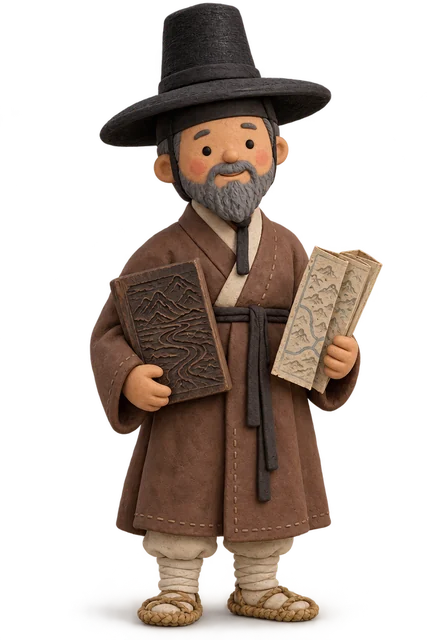
Kim Jeong-ho, who made the Cheonggudo and the 22-volume woodblock-printed Daedong Yeojido of 1861, left almost no record of his life, but he was a geographer who carefully compared earlier maps and books to complete an accurate map of Joseon.
Do you have to walk all over the country to make a good map? Kim Jeong-ho, thought to have been a commoner craftsman, published the Cheonggudo and then, in 1861, the 22-volume woodblock-printed Daedong Yeojido. Stories that he climbed Baekdusan and walked across the whole country, or that Heungseon Daewongun burned the woodblocks, are thought to have been made up in the Japanese colonial period; in fact he made his maps by carefully comparing earlier maps and books. His story shows that steadily organizing sources can achieve great things.
More detail
Two sources checked
Do you have to walk all over the country yourself to make an accurate map? Kim Jeong-ho's pen name was Gosanja. He left many maps, but there are very few old records about him, so it is not certain when he was born and died or where he lived. Because there is no family genealogy record for him, he is thought to have been a commoner, not a yangban (the noble class), and a craftsman with outstanding skill in carving letters and pictures on wooden blocks.
In 1834 he made the atlas Cheonggudo and revised it several times. In the same year, at the request of his friend Choe Han-gi, he carved a Western-style world map, the Jigu Jeonhudo, on wooden blocks, and in the 1840s he also made a woodblock-printed map of Seoul, the Suseon Jeondo. It was like a friend with great skill who carved a cool poster for a friend who asked.
In 1861 he published the 22-volume woodblock-printed Daedong Yeojido. He divided the country into 22 north-to-south sections and folded each section to 20 cm by 30 cm, so it could be carried around like a book. It has more than 13,000 place names, and its mountain ridges, waterways and roads are drawn so they are easy to recognize. It was like a phone map app, where you take out only the part you need.
Alongside maps, he also wrote geography books. He compiled the Yeodo Biji with Choe Seong-hwan, and he died while writing his last work, the Daedong Jiji, without finishing it.
But the stories we often hear, that he climbed Baekdusan many times and walked across the country, or that Heungseon Daewongun burned the map's woodblocks and jailed him, were made up in the Japanese colonial period. Some of the actual woodblocks still survive today. Kim Jeong-ho carefully gathered and compared earlier maps and books to make a map that was easy to use and accurate. His story tells us today that calm organizing of sources achieves more than a fine tale.
Life timeline
- 1834Makes the Cheonggudo
In the same year he carved the world map Jigu Jeonhudo on wooden boards. - 1864Revises and reprints the Daedong Yeojido