 BETA
Person
Kim Jeong-hui
1786–1856 · Calligrapher of Joseon · Joseon
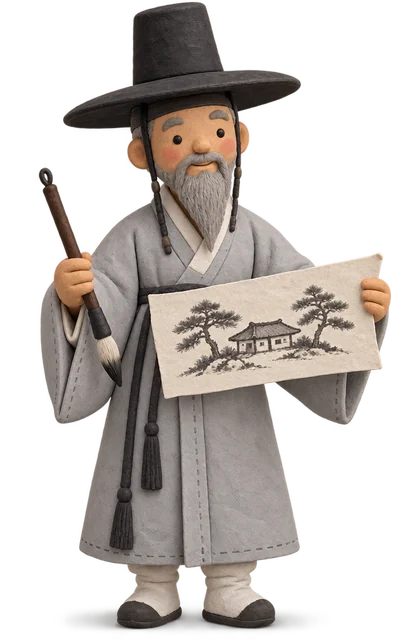
He was a calligrapher and epigraphy scholar who created the Chusa style.
Kim Jeong-hui was a calligrapher who wrote very well. He studied old stone monuments and found that a monument on Bukhansan had been set up in the time of King Jinheung. During the nine years he lived in exile on Jeju Island, he perfected his own style of writing, the Chusa style. He painted the Sehando at this time too.
More detail
Two sources checked
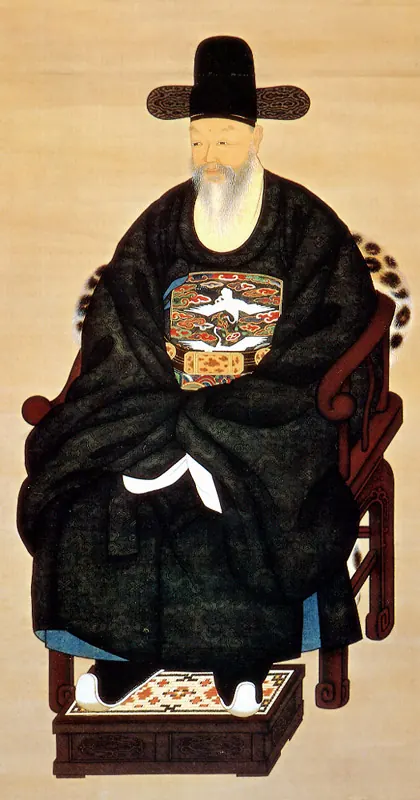
Kim Jeong-hui, whose pen name was Chusa, was born into a famous family linked to the royal house by marriage. As a boy he studied under Bak Je-ga and became aware of the new learning of Qing China (evidential scholarship, or gojeunghak).
In 1809, at the age of 24, he accompanied his father, who was going as an envoy, to Beijing in Qing China, where he met great scholars such as Weng Fanggang and Ruan Yuan. After returning home he kept exchanging letters with them and studying together. He delved deeply into geumseokhak, the study of the writing carved on old stone monuments and metal objects.
In 1816 he examined a monument standing on Bibong Peak on Bukhansan. Until then people had believed it to be the monument of the monk Muhak. The next year he went again, read 68 of its characters, and proved that it was a royal tour monument (sunsubi) set up by King Jinheung of Silla.
In 1819 he passed the civil service examination and held posts such as head of the Seonggyungwan (the national academy) and vice-minister of the Ministry of Military Affairs. But in 1840 he was caught up in a political incident and exiled to Jeju Island, where he spent nine years. There, after studying old calligraphy widely, he completed the powerful and distinctive Chusa style of writing. In 1844 he painted Sehando (Winter Scene) for Yi Sang-jeok, an interpreter (yeokgwan) who had stayed loyal to him and looked after him even in his hard circumstances.
In 1851 he was exiled again, to Bukcheong in Hamgyeong Province. He returned the next year, lived in Gwacheon, and died in 1856. Many people followed his scholarship and art. One of them was Yi Ha-eung, who later became the Heungseon Daewongun, and who became a master of orchid painting.
Life timeline
- 1809Traveled to Yanjing (Beijing) in Qing China
- 1816Examined the monument on Bukhansan
He examined it again the next year and confirmed that it was a royal tour monument of King Jinheung. - 1819Passed the civil service examination
- 1840Exiled to Jeju Island
He stayed there for nine years. - 1844Painted Sehando
He painted it for his student Yi Sang-jeok, who had not forgotten him in exile. - 1851Exiled to Bukcheong in Hamgyeong Province
He was released the next year.