 BETA
Person
Lee Jung-seop
1916–1956 · A painter · Republic of Korea
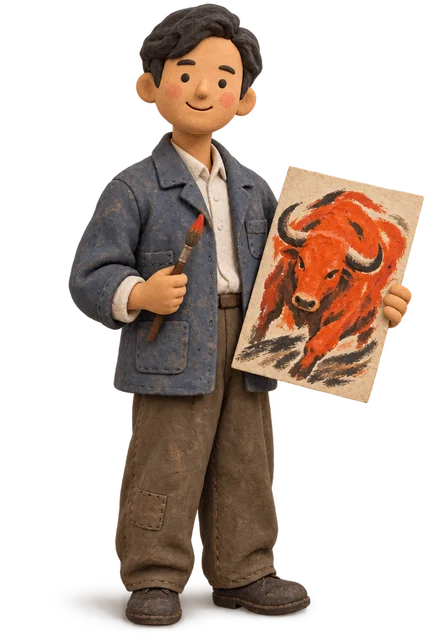
A painter famous for his powerful paintings of oxen.
He was a painter famous for paintings of powerfully moving oxen. During the Korean War (known in Korea as the 6·25 War), he fled to Seogwipo on Jeju and lived in poverty. Without art materials, he sometimes drew on the silver foil inside cigarette packs.
More detail
Two sources checked
Lee Jung-seop was born in 1916 in Pyeongwon, South Pyeongan Province. He met an art teacher at Osan Higher Common School in Jeongju and nurtured his dream of becoming a painter, and after graduating in 1936 he studied Western painting in Tokyo, Japan. He made his name from his student days by winning prizes at exhibitions.
In 1945 in Wonsan he married the woman he had met during his studies in Japan, and they had two sons. When the Korean War broke out in 1950, he fled with his family and in 1951 spent nearly a year in Seogwipo on Jeju Island. They lived poorly in a small room, but at this time he often painted children playing by the sea and his family.
In 1952, life became too hard, and his wife and children left for Japan. Left alone, he missed his family and sent letters and pictures, and without materials he sometimes drew as if engraving on the silver foil from cigarette packs.
His pictures of oxen, such as the powerful White Ox, charging with its head lowered, are especially famous. In 1955 he held a solo exhibition at the Midopa Gallery in Seoul, but his circumstances did not improve, and as his body and mind weakened he died in Seoul in September 1956 at the age of forty.
Life timeline
- 1945Marries in Wonsan
- 1951Takes refuge in Seogwipo
- 1955Holds a solo exhibition at the Midopa Gallery in Seoul