 BETA
Person
Sunni Ali
?–1492 · King of the Songhai Empire · Songhai Empire
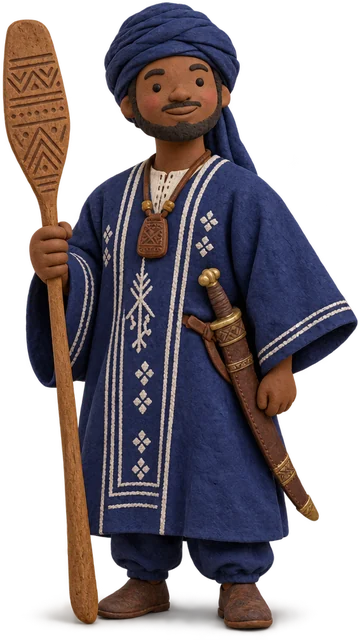
A Songhai king who took the throne around 1464 and used cavalry and boats on the Niger River to take Timbuktu and Djenne, growing the small kingdom of Gao into a great empire of West Africa. He is judged differently in the scholars' books and in the stories of the Songhai people.
How did the small kingdom of Gao become a great empire? Sunni Ali became king around 1464, used cavalry and boats together, went on campaign nearly every year, and took Timbuktu and Djenne. In the scholars' books he is remembered as a cruel king, but in the stories of the Songhai people he is a great hero. It is said that he died in 1492 while crossing a river. His story shows that the same person can look different depending on who writes about him.
More detail
Two sources checked
How did the small kingdom of Gao become a great empire of West Africa? At the center was Sunni Ali (Ali Ber). He was a king of the Sunni dynasty of Gao and took the throne around 1464.
His weapons were swift cavalry and boats on the Niger River. Using horses on land and boats on the river together, he went on campaign almost every year. It was like putting a track athlete and a swimmer on the same team.
In 1468 he took Timbuktu from the Tuareg. Around 1473 he took Djenne, which is surrounded by water, after a long siege. He also held off attacks from the Mossi in the south and the Tuareg in the north. He did not only attack but also put effort into defending his country.
He was a Muslim, but he also honored the traditional beliefs of Songhai. That is why opinions of him split in two. The history books written by Timbuktu scholars drew him as a cruel king who tormented scholars. But in the stories of the Songhai people today he is remembered as a great hero with magical powers. Depending on who writes the record, the same person looks this different.
It is said that in 1492, on his way back from a campaign, he died while crossing a river. Not much is known for certain about his death. This story reminds us that when we read history, we should also look at who wrote it.
Life timeline
- 1464Became king