 BETA
Person
Modu Chanyu
?–174 BCE · Xiongnu ruler (chanyu) · Xiongnu
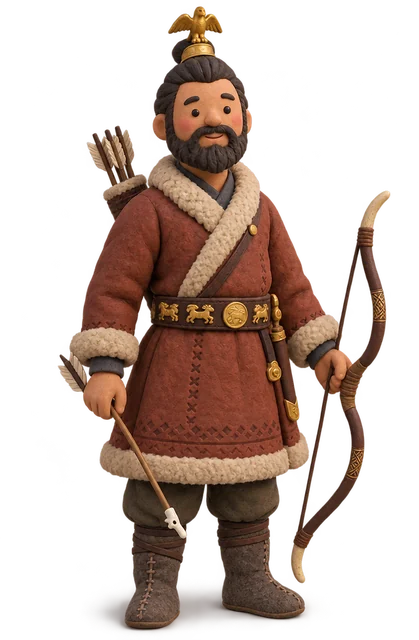
He was the ruler who drove out his father and became chanyu in 209 BCE, making the Xiongnu the first great nomadic state of the steppe. He also stood up to the Han and forced them into a peace-and-kinship agreement.
How did a son sent away as a hostage become master of the steppe? Modu stole a horse from the Yuezhi and came home, and he trained his horsemen strictly. In 209 BCE he drove out his father, became chanyu and united the Xiongnu. He surrounded the Han emperor and forced a peace agreement, and he also set up a framework for ruling the state in divisions. He was cold-blooded, but he laid the foundation of a state that lasted hundreds of years, and his story shows that for a state to last, it needs institutions.
More detail
Two sources checked
How did an eldest son sent away as a hostage become master of the steppe? Modu (also written Maodun) was the eldest son of the Xiongnu leader Touman Chanyu. His father sent him as a hostage to the Yuezhi in the west so that another son could become heir, but Modu stole a fine Yuezhi horse and rode home, and was given command of 10,000 horsemen. He must have felt he had to make a place to return to for himself.
He trained his soldiers strictly with the whistling arrow (myeongjeok), and in 209 BCE he shot his father down with this arrow and made himself chanyu. Soon he destroyed the Donghu in the east and drove out the Yuezhi in the west, and he won back the southern land that the Qin general Meng Tian had taken. A tragedy inside a family became the beginning of a state.
In 200 BCE he surrounded Emperor Gaozu of Han, Liu Bang, for seven days at Baideng Mountain. After that, the Han agreed to a peace-and-kinship arrangement: every year they sent silk, liquor and grain, and married a woman of the imperial family to the chanyu. It was like a strong class making a truce with a weaker class on the condition of getting snacks every month.
Modu set up a framework for governing the state in divisions, with Wise Kings of the Left and Right and 24 chiefs. He is remembered for the cold-bloodedness of killing his father, but he is also judged as the person who joined scattered nomadic tribes and laid the foundation of a state that lasted hundreds of years. He died in 174 BCE and his son Laoshang Chanyu succeeded him. This story shows that one person's strength can found a state, but for that state to last, it needs institutions.
Life timeline
- 174 BCEDied; his son Chanyu Laoshang succeeded him