 BETA
Person
Simon Bolivar
1783–1830 · Liberator of South America · Republic of Peru
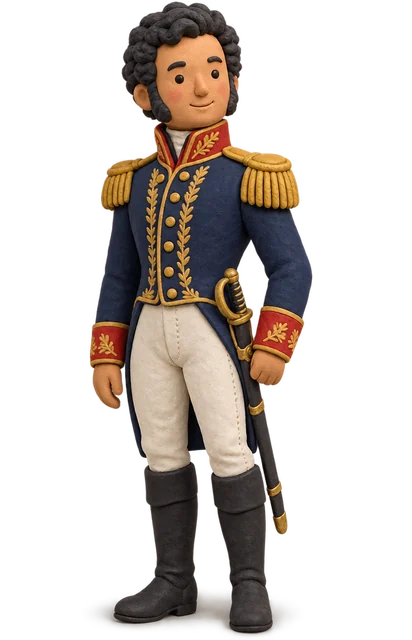
Born in Venezuela, he was the "Liberator" who freed Venezuela, Colombia and Ecuador and came to Peru in 1823 to finish the war of independence. But the great union of South America that he hoped for was never achieved.
Can one person lead the independence of many countries? Bolívar, born in Venezuela, rose again after losing many times and freed several countries, and in 1823 he came to Peru and finished the war of independence. But the great union he hoped for never came true, and he died in 1830. Bolivia took its name from him, and his story makes us think about big dreams and the balance of power.
More detail
Two sources checked
Can one person lead the independence of many countries? Simón Bolívar was born in 1783 into a wealthy family in Caracas, Venezuela. He lost his parents young, and while traveling in Europe he learned the ideas of freedom and the republic. In 1810 he joined the Venezuelan independence movement.
The road was not smooth. He went through the hardship of losing many times and going into exile, but in 1819 he crossed the Andes, won the Battle of Boyacá and founded Gran Colombia. He freed Venezuela in 1821 and Ecuador in 1822. His meeting with San Martín in Guayaquil in the same year is counted as a major turning point of the wars of independence. After that meeting San Martín stepped aside, and it can be said that the way opened for Bolívar to come to Peru.
At the repeated request of the Peruvian Congress he came to Peru in September 1823, and in February 1824 he became dictator with full powers. He rebuilt his army in Trujillo in the north and won the Battle of Junín in August, and in December Sucre won at Ayacucho, ending Spanish rule. The country founded the next year on the southern highlands of Peru (today's Bolivia) took his name and became "Bolivia."
But the twist was bitter. Bolívar left Peru in 1826, but the great union of South American countries that he hoped for was never achieved. Gran Colombia also began to split apart, and he died in 1830 in Santa Marta, Colombia.
He is respected as the "Liberator" in many countries, but he is also criticized for trying to hold strong power. His life asks us today how hard it is to balance achieving a big dream with sharing power.
Life timeline
- 1819Won the Battle of Boyaca and founded Gran Colombia
- 1825The new country of Bolivia was named after him
- 1826Left Peru and returned to Gran Colombia
- 1830Died in Santa Marta, Colombia