 BETA
Person
Lord of Sipan
active 220–300 CE · Moche lord · Moche Culture
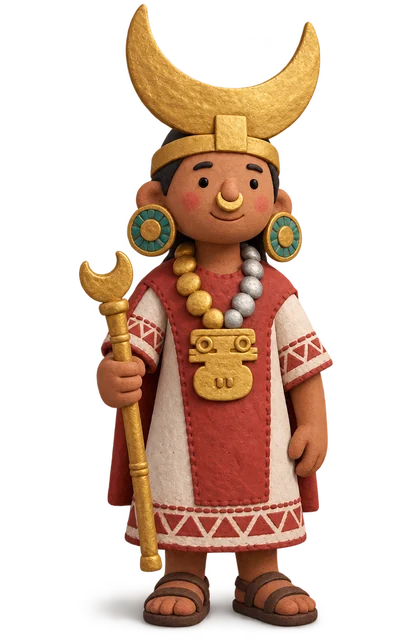
He was a Moche ruler buried around 250 CE in a gold mask and ornaments, and the owner of the first royal tomb in South America found unlooted.
The Lord of Sipan was a Moche ruler who governed Peru's northern coast about 1,800 years ago. He was buried inside a mud-brick platform wearing a gold mask and a gold necklace. His tomb was found unlooted, just as it had been left.
More detail
Two sources checked
The Lord of Sipan was a Moche ruler who governed the Lambayeque valley on Peru's northern coast around the 3rd century. Because no writing survives, his real name cannot be known, and he is called the 'Lord of Sipan' after the name of the town where his tomb was.
He was about 1.65 m tall and appears to have died a little over thirty years old. His tomb lay deep inside a large platform built of adobe, and carbon dating indicated that he was buried around 250 CE.
Inside the wooden coffin he wore a gold crescent headdress, a gold mask, gold earrings set with turquoise, and a necklace of peanut-shaped beads of gold and silver. In his hands he held a scepter, a symbol of one who rules, and around him were placed people buried with him and pottery.
Moche pottery and murals often show a 'warrior priest' who leads sacrifices, and his dress closely resembles those pictures. As a result, the view that the Moche lord led both war and sacrifice gained strength.
His tomb was found by an excavation team in 1987 and can now be seen at the Royal Tombs of Sipan Museum in Lambayeque. An earlier tomb, that of the 'Old Lord of Sipan,' was found at the same site.
Related events
- 250 CEThe Lord of Sipan Is Buried with Gold and Silver Ornaments
- 1987Excavation of the Royal Tombs of Sipan