 BETA
Person
Catherine II
1729–1796 · Empress of Russia · Russian Empire
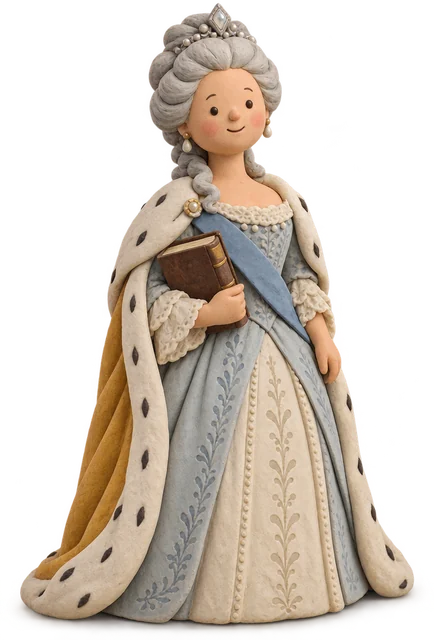
Born the German princess Sophie, she came to Russia at fifteen and became Catherine. She took the throne in a coup in 1762 and ruled for 34 years, promoting Enlightenment ideas and greatly expanding Russia's territory. But the nobles' privileges grew and serfdom became harsher.
How did the princess of a small German state become the ruler of Russia? Sophie came to Russia at fifteen and became Catherine. She took the throne in a coup in 1762, cherished learning and art, and greatly expanded Russia's land. But the nobles' privileges grew, and the lives of serfs became harder. It makes us think that fine words and real change can be different things.
More detail
Two sources checked
How did the princess of a small German state become the ruler of Russia? Catherine II was born as Princess Sophie in 1729 in Stettin, Prussia (today's Szczecin, Poland). She came to Russia at fifteen, joined the Orthodox Church and received the name Catherine, and in 1745 she married the man who would later become Peter III.
The marriage was unhappy, but during those years she read the books of Voltaire and Montesquieu eagerly. She was like a student who, in a hard time, took refuge in the library and escaped into books. In 1762 a coup by the Guards drove out her husband, and she became empress.
As empress she exchanged letters with Voltaire and Diderot. She wrote the Instruction, full of Enlightenment ideas, and opened a legislative commission, and she led the way with the Hermitage collection, the Smolny Institute for girls, and smallpox vaccination. Abroad, she won two wars against the Ottoman Empire, took Crimea in 1783, and greatly expanded Russia's western lands through the partitions of Poland.
But the story has a dark side. The Charter to the Nobility of 1785 made the nobles' privileges even greater, and serfdom grew heavier, with serfs not even allowed to bring complaints against their masters. She crushed the Pugachev rebellion, and after the French Revolution she sent critics such as Radishchev into exile. In a place where no one could say that it hurt, the serfs probably suffered even more.
She died in the Winter Palace in 1796. She had ruled Russia for 34 years. The fact that she spoke of enlightenment but did not change the lives of the serfs makes us think today that the values people announce and the people they actually protect are not always the same.
Life timeline
- 1744Came to Russia and received the name Catherine
- 1745Married the future Peter III
- 1768Was inoculated against smallpox herself
- 1785Issued the Charter to the Nobility
Related events
- 1762Catherine II Takes the Throne (the Coup of 1762)
- 1764Beginning of the Hermitage Art Collection
- 1764Founding of the Smolny Institute for Girls
- 1767Catherine's Instruction (Nakaz) and the Legislative Commission
- 1768Russo-Turkish War and the Treaty of Kuchuk Kainarji
- 1772Partitions of Poland
- 1773Pugachev's Rebellion
- 1783Annexation of Crimea and the Building of Sevastopol
- 1790Radishchev's Journey from Saint Petersburg to Moscow