 BETA
Person
Lenin
1870–1924 · Supreme leader of Soviet Russia · Soviet Russia
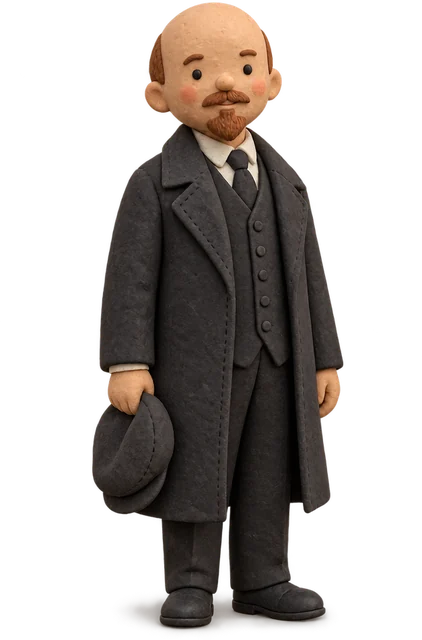
Lenin (Vladimir Ulyanov) was a Bolshevik leader born in 1870 in Simbirsk. He led the October Revolution of 1917 and set up the world's first socialist government, also built the framework of one-party dictatorship, and died in January 1924.
Why did Lenin become a revolutionary? After his older brother was executed over a plot to assassinate the tsar, he walked the path of a revolutionary, and with the October Revolution of 1917 he set up the world's first socialist government. But he got rid of other parties and built the framework of a one-party dictatorship. His story shows that we must also weigh how a dream was achieved.
More detail
Two sources checked
Why would a person bet his whole life on revolution? Lenin's real name was Vladimir Ilyich Ulyanov. He was born in 1870 in Simbirsk (today's Ulyanovsk) on the Volga River, the son of a school inspector. The event that changed his life most happened in 1887: his older brother Alexander took part in a plot to assassinate the tsar and was executed.
After that Lenin was expelled from university, read Marx's books, and became a revolutionary. What happened to his brother may have stayed deep in his heart. In 1895 he was arrested and exiled to Siberia, and in 1898 he married Krupskaya there. Afterward he lived in exile in Europe for a long time, writing newspapers and books. In 1903 the people who followed him became the "Bolsheviks" (the majority).
His chance came in 1917. Hearing news of the February Revolution, he returned in April and shouted, "All power to the soviets!" Through the October Revolution he seized power and became chairman of the Council of People's Commissars. He made peace with Germany and won the civil war, and in 1921 he changed course with the New Economic Policy.
But his victory came with a dark side. He banned other parties and built the framework of a one-party dictatorship that crushed opponents with the secret police, the Cheka. It was like not letting anyone give a different opinion at a class meeting. After being shot in 1918, his health got worse, and after strokes beginning in 1922, he died in January 1924.
In the Soviet Union he was worshipped almost like a god, but today he is judged both as a leader of revolution and as a man who opened the door to dictatorship. Lenin's story tells us that we must also weigh the way a great dream was achieved.
Life timeline
- 1887His brother Alexander was executed
- 1898Married Krupskaya in Siberian exile
- 1918Shot and badly wounded in Moscow
- 1922Suffered his first stroke
Related events
- 1917Lenin's Return and the April Theses
- 1917The Decree on Peace and the Decree on Land
- 1917October Revolution
- 1918Treaty of Brest-Litovsk
- 1918The Capital Moves to Moscow
- 1918Russian Civil War and War Communism
- 1921Kronstadt Sailors' Rebellion
- 1921New Economic Policy (NEP)
- 1922Founding of the Soviet Union (Union of Soviet Socialist Republics)
- 1924Lenin's Death and Lenin's Mausoleum