 BETA
Person
Alexander Pushkin
1799–1837 · Poet and novelist · Russian Empire
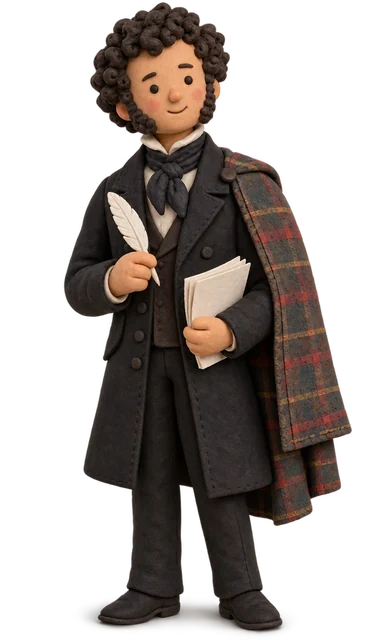
The 'father of Russian literature,' who opened modern Russian literature and wrote Eugene Onegin and The Captain's Daughter.
Pushkin is the poet Russians love most. He wrote poems and novels in plain Russian, so he is called the 'father of Russian literature.' He died in a duel at the age of thirty-seven.
More detail
Two sources checked
Alexander Pushkin was born in 1799 into a noble family in Moscow. His great-grandfather on his mother's side was Abram Gannibal, who had come from Africa and won the trust of Peter the Great. The Russian folk tales told by his nurse had a great influence on his literature.
In 1811 he became a student at the first class of the Tsarskoye Selo Lyceum, and at fifteen he published a poem and became known. Because of poems that sang of freedom, from 1820 he was exiled to the southern provinces and to his country estate. He had many friends among the Decembrists, but he was in exile at the time and did not take part in the uprising.
He left works in many genres, including Ruslan and Lyudmila, the verse novel Eugene Onegin, the historical drama Boris Godunov, and The Captain's Daughter, which deals with the Pugachev rebellion. He wrote in a Russian close to the language people actually used, and is considered to have laid the foundation of the modern Russian literary language.
In 1837, over rumors about his wife, he fought a duel with Dantes, an officer of French origin, was badly wounded, and died two days later. He was thirty-seven. Even now Russians count him as their best-loved poet.
Life timeline
- 1811Entered the Tsarskoye Selo Lyceum
- 1820Sent south because of poems that sang of freedom
- 1836Published The Captain's Daughter