 BETA
Person
Stalin
1878–1953 · Supreme leader of the Soviet Union · Soviet Union (Union of Soviet Socialist Republics)
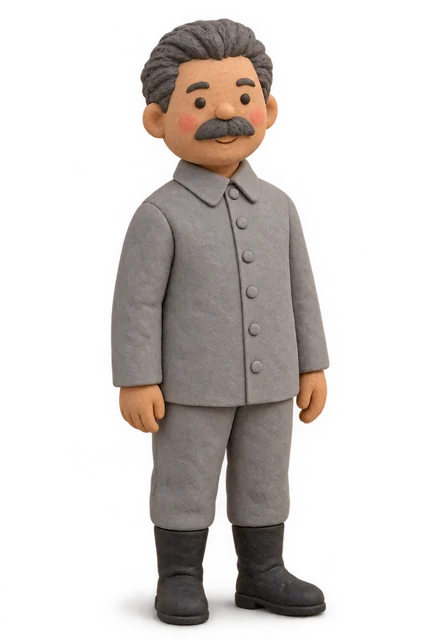
Stalin was born in 1878 in Gori, Georgia. After Lenin he led the Soviet Union alone, achieved industrialization through Five-Year Plans, and won the German-Soviet War, but he was a dictator whose rule caused countless victims through famine and the Great Purge, and he died in 1953.
How did Stalin come to lead the Soviet Union alone? As General Secretary he held control of the party's appointments and pushed out his rivals, and he led industrialization and victory in the German-Soviet War. But countless people lost their lives to famine and the Great Purge, and he was criticized after his death. His story helps us not forget the pain behind rapid growth.
More detail
Two sources checked
What path did a man who gave himself the name "man of steel" walk? Stalin's real name was Iosif Dzhugashvili. He was born in 1878 in Gori, Georgia, the son of a shoemaker, attended a seminary, and then threw himself into the revolutionary movement. "Stalin" means "man of steel," a name he gave himself. He was arrested many times and exiled to Siberia, and after the revolution of 1917 he became People's Commissar for Nationalities.
In 1922 he became General Secretary of the Communist Party and took hold of the party's appointments. In class terms, it was like being in charge of deciding every group's seating. After Lenin died he pushed out his rivals one after another, including Trotsky, Zinoviev, and Bukharin, and around 1929 he came to lead the Soviet Union alone.
With the Five-Year Plans he built factories and power plants quickly, but the price of that speed was huge. The collectivization of agriculture caused the great famine of 1932-1933, and millions of people starved to death. During the Great Purge of 1936-1938, countless people, including old comrades, army commanders, and even ordinary citizens, were executed or sent to camps, and in 1937 he forcibly moved the Koreans of the Maritime Province (Primorye) to Central Asia.
In 1939 he signed a non-aggression pact with Germany but was invaded in 1941. After enormous sacrifice the Soviets won at Stalingrad and Kursk and took Berlin in 1945, and at the Yalta and Potsdam conferences he discussed the postwar world. After the war he set up communist governments in Eastern Europe and fought the Cold War with the United States, and in 1950 he approved Kim Il-sung's plan to invade the South.
He died of a stroke on March 5, 1953. In 1956 Khrushchev criticized his cult of personality and the purges, and in 1961 his body was moved out of Lenin's tomb and buried beside the Kremlin wall. Estimates of the number of people who died in his era vary widely, from 6 million to 20 million. Not forgetting the suffering of the people hidden behind rapid growth is what we can learn from this today.
Life timeline
- 1922Became General Secretary of the Communist Party
- 1941Became Chairman of the Council of People's Commissars (head of government)
- 1945Attended the Potsdam Conference
He discussed with the American and British leaders how to handle Germany and Japan's surrender. - 1950Approved North Korea's plan to invade the South
He accepted Kim Il-sung's request, allowing and helping the Korean War. - 1953Died at his dacha near Moscow
- 1961Removed from Lenin's Mausoleum and buried beside the Kremlin wall
Related events
- 1917October Revolution
- 1922Founding of the Soviet Union (Union of Soviet Socialist Republics)
- 1927Stalin Seizes Power and Trotsky Is Exiled
- 1928First Five-Year Plan
- 1929Collectivization of Agriculture and the Great Famine (Holodomor)
- 1936Great Purge
- 1937Forced Removal of the Koryo-saram of Primorye to Central Asia
- 1939German-Soviet Non-Aggression Pact and the Occupation of Eastern Europe
- 1939The Winter War (Soviet-Finnish War)
- 1941Battle of Moscow
- 1941German Invasion of the Soviet Union and the Start of the Great Patriotic War
- 1942Battle of Stalingrad
- 1945Capture of Berlin and Victory Day
- 1945Soviet Entry into the War Against Japan and the Advance into Manchuria and Northern Korea
- 1945Yalta Conference (from the Soviet Side)
- 1948Berlin Blockade
- 1949First Soviet Atomic Bomb Test
- 1950The Korean War (June 25 War) and the Soviet Union
- 1953Death of Stalin