 BETA
PersonMyth
Thor
God of thunder · Scandinavia
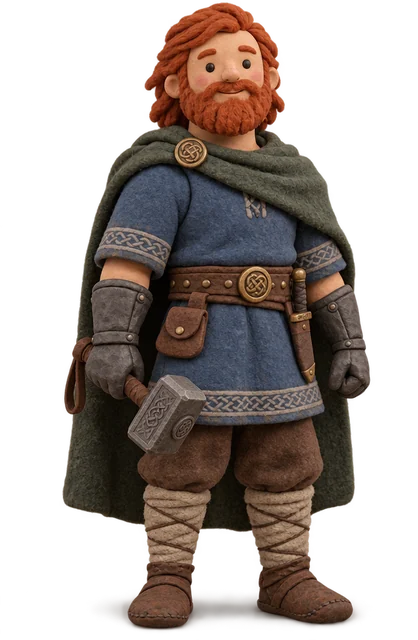
In Norse mythology, he is the strong god of thunder who swings the hammer Mjolnir and protects gods and people from giants.
Thor is the thunder god who carries the hammer Mjolnir. He was very strong and is said to have protected gods and people from giants. The English word Thursday means 'Thor's day'.
This comes from a myth. The story has been passed down from long ago, so we cannot know whether it really happened.
- Who tells this story
- The Poetic Edda (the Icelandic manuscript called the Codex Regius, late 13th century) and Snorri Sturluson's Prose Edda (early 13th century); Viking Age hammer pendants and runestones
- What is and is not confirmed
- Confirmed: these stories were written down in 13th-century Iceland, and runestones, picture stones and jewelry from the earlier Viking Age carry the same gods and scenes. Not confirmed: stories about the gods are myths that express belief, so they are not something to judge as history. The people who wrote them down were already Christians, so scholars disagree about whether they match the old beliefs or changed some parts.
More detail
Two sources checked
Thor is the son of Odin, a god of thunder with a red beard and enormous strength. He rode in a cart pulled by two goats, and people believed that thunder sounded when the cart passed.
His treasure is the hammer Mjolnir, made by dwarfs. When thrown, it always hits its target and returns to his hand. With this hammer Thor held back the giants and protected the land of the gods and the land of humans. There is also a funny tale in which, after a giant stole the hammer, he disguised himself as a bride and got it back.
For ordinary people of the Viking Age, Thor was the most familiar god. They prayed to him for weather, farming and safe travel, and wore necklaces in the shape of a small hammer. In the 11th century Adam of Bremen wrote that there was a statue of Thor in the middle of the temple at Uppsala.
The English Thursday comes from 'Thor's day.'