 BETA
Person
Andrew Carnegie
1835–1919 · Steel businessman · United States
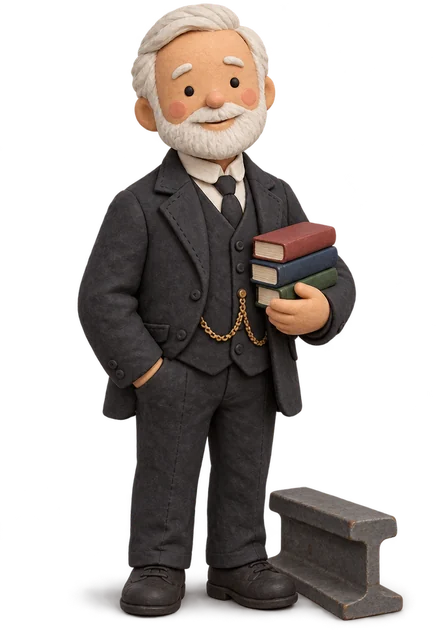
He went from a poor immigrant boy to the "Steel King," and gave the money he earned to libraries and schools.
Carnegie was a poor immigrant boy. He founded a steel company and became the richest man in America. With his money he built more than 2,500 libraries around the world.
More detail
Two sources checked
Andrew Carnegie was born in 1835 in Dunfermline, Scotland, the son of a poor weaver. In 1848 he immigrated with his family to near Pittsburgh in the United States, and at thirteen he worked winding thread in a cotton mill.
After working as a telegraph messenger, he learned business while working for a railroad company, and foresaw that much steel would be needed for railroads and bridges. In the 1870s he built a large steel mill in Pittsburgh and introduced a new steelmaking process to make steel cheaply and in large quantities.
His company became the largest steel company in America, but during the 1892 strike at the Homestead plant, workers and guards clashed and several people died.
After selling the company and retiring in 1901, he gave away most of his fortune, saying that 'to die rich is to die disgraced'. He built more than 2,500 public libraries around the world and founded Carnegie Hall and several foundations. He died in 1919.
Life timeline
- 1848Immigrated to the United States with his family
- 1892The Homestead strike broke out
- 1901Sold the Carnegie Steel Company and retired