
Person
Franklin D. Roosevelt
1882–1945 · 32nd President of the United States · United States
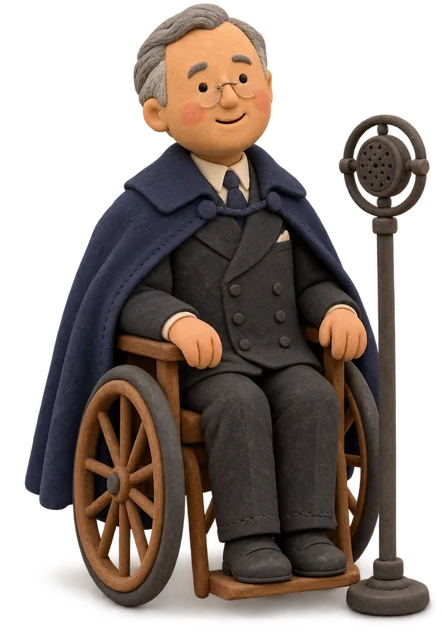
He was the president who tried to overcome the Great Depression with the New Deal, led the country in World War II, and at the Cairo Conference made the first international promise of Korea's independence.
Franklin D. Roosevelt had trouble with his legs, but he was elected president four times. He tried to overcome the Great Depression by creating jobs with the "New Deal." At the Cairo Conference in 1943 he made the first promise to make Korea independent.
More detail
Two sources checked
Franklin Roosevelt was born in 1882 into a wealthy family in New York. He was a distant relative of Theodore Roosevelt, and his wife Eleanor was Theodore's niece. While serving as assistant secretary of the navy and in other posts, he lost the use of both legs to polio in 1921, but he did not give up politics and became governor of New York in 1929.
Becoming president in 1933, at the height of the Great Depression, he carried out a set of policies called the 'New Deal'. He reformed the banks, created jobs through dam and road construction, and in 1935 created the Social Security system to help the elderly and the unemployed. Through his 'fireside chats', in which he spoke directly to the people by radio, he reassured them. He is the only president in American history elected four times.
When Japan attacked Pearl Harbor in December 1941, he brought the country into World War II. During the war he issued the order to confine about 120,000 Japanese Americans in camps, for which he was later heavily criticized. In November 1943 at Cairo he met the British and Chinese leaders and declared that 'in due course Korea shall become free and independent', which was the first international document to promise Korean independence. In February 1945 at Yalta he discussed the postwar world with the British and Soviet leaders.
He died of a cerebral hemorrhage in April 1945, a few months before the war ended. The United Nations (UN), which he had envisioned, was launched that October.
Life timeline
- 1921Lost the use of his legs to polio
- 1929Became governor of New York
- 1933Took office as president
- 1935Signed the Social Security Act
- 1941Decided to enter World War II
- 1943Attended the Cairo Conference
- 1945Attended the Yalta Conference
- 1945Died in office
Related events
- 1931Construction of the Hoover Dam
- 1933Bank Holiday and Deposit Insurance
- 1933Civilian Conservation Corps (CCC)
- 1933The New Deal
- 1933Founding of the Tennessee Valley Authority
- 1934Indian Reorganization Act
- 1935The Neutrality Acts Era
- 1935The Social Security Act
- 1935National Labor Relations Act (Wagner Act)
- 1935Works Progress Administration (WPA)
- 1937Court-Packing Plan
- 1941Atlantic Charter
- 1941Executive Order 8802 and the Fair Employment Practice Committee
- 1941The Lend-Lease Act
- 1941Attack on Pearl Harbor and America's Entry into the War
- 1942Incarceration of Japanese Americans
- 1942Manhattan Project and the Atomic Bomb
- 1943Cairo Conference and the Promise of Korean Independence
- 1944Servicemen's Readjustment Act (GI Bill)
- 1945Signing of the United Nations Charter