 BETA
Person
Benjamin Franklin
1706–1790 · Scientist and diplomat · United States
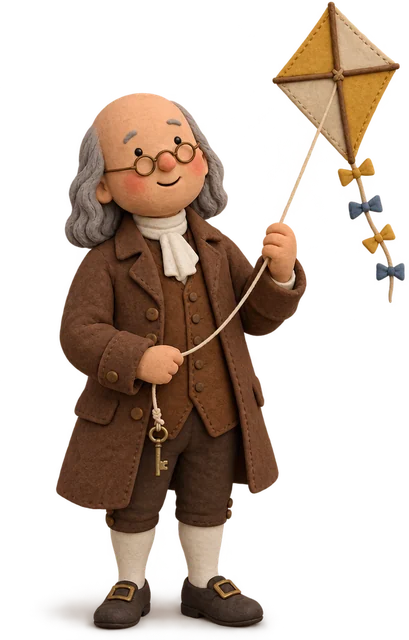
He was a scientist who showed that lightning is electricity, and a diplomat who took part in the Declaration of Independence and the Constitution.
It is said that Benjamin Franklin flew a kite to show that lightning is electricity. He also made useful things such as the lightning rod. He also helped write the Declaration of Independence and the Constitution.
More detail
Two sources checked
Benjamin Franklin was born in Boston in 1706, the fifteenth child of a candle maker. He attended school for only two years, and educated himself by reading while working in his brother's print shop. At seventeen he went to Philadelphia and succeeded as a printer.
He published Poor Richard's Almanack and won great popularity with short sayings such as 'Early to bed and early to rise makes a man healthy, wealthy and wise'. He also took the lead in founding a library, a fire company and a college (now the University of Pennsylvania).
Around 1752 he is said to have shown that lightning is electricity through an experiment of flying a kite in a storm. He also invented the lightning rod, bifocal glasses and a stove, but did not patent them.
As a statesman, he proposed a union of the colonies in 1754 and helped polish the Declaration of Independence. In 1776 he went to France and secured an alliance, and in 1783 he also signed the Treaty of Paris. In 1787, at the age of 81, he attended the Constitutional Convention, and in his last years he served as president of an anti-slavery society. He died in Philadelphia in 1790.
Life timeline
- 1732Published Poor Richard's Almanack
- 1752Showed through a kite experiment that lightning is electricity
- 1776Sent to France as an envoy
- 1787Became president of an anti-slavery society
Related events
- 1732Poor Richard's Almanack
- 1752Franklin's Kite Experiment (Lightning and Electricity)
- 1754Albany Congress and the Plan of Union
- 1754French and Indian War
- 1775The Second Continental Congress and the Creation of the Continental Army
- 1776Declaration of Independence
- 1777The Battle of Saratoga and the Alliance with France
- 1783Treaty of Paris: Britain Recognizes American Independence
- 1787Writing of the United States Constitution