 BETA
Person
Abraham Lincoln
1809–1865 · 16th President of the United States · United States
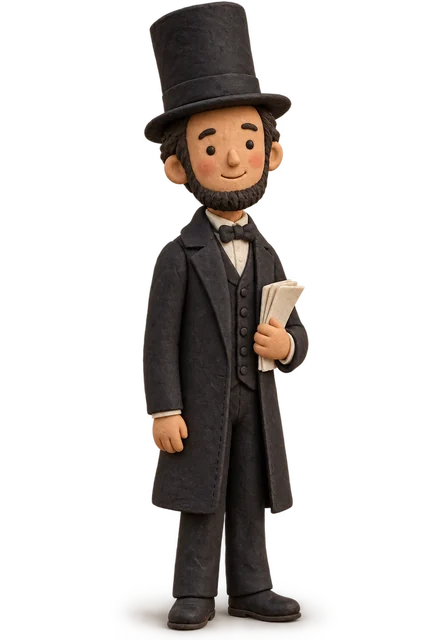
Abraham Lincoln went from a poor log-cabin boy to president; he held the Union together during the Civil War, declared the freeing of enslaved people, spoke of "government of the people, by the people, for the people," and was assassinated in 1865.
Abraham Lincoln was born in a poor log cabin and taught himself until he became president. During the Civil War he kept the country from breaking in two. He declared the emancipation of enslaved people and left the words "government of the people, by the people, for the people."
More detail
Two sources checked
How did a poor boy born in a log cabin become the president of a country? Abraham Lincoln was born in 1809 in a log cabin in Kentucky, the son of a poor farmer, and grew up on the frontier of Indiana and Illinois. He went to school for only a little more than a year in total.
Still, he read borrowed books, taught himself, and became a lawyer. Today it would be like building your skills from books alone without ever going to a single cram school. He served in the Illinois legislature and in the U.S. House of Representatives, and in 1858 he became known across the country for his debates with Stephen Douglas about expanding slavery, during a Senate race.
In 1860 he was elected president as the candidate of the Republican Party, which opposed the expansion of slavery. Southern states then left the Union, and the Civil War began in 1861. It was as if one class split in two and said each half would go its own way: the country was in danger of breaking apart. Above all, Lincoln wanted to save the Union.
As the war dragged on, on January 1, 1863, he issued the Emancipation Proclamation, freeing enslaved people in the Confederate territory. In November of that year, in a short speech at the Gettysburg soldiers' cemetery, he urged people to protect "government of the people, by the people, for the people."
He was re-elected in 1864, and in January 1865 Congress passed the Thirteenth Amendment, which abolished slavery. In April of that year, five days after the Southern army surrendered, Lincoln was watching a play at Ford's Theatre in Washington when he was shot by John Wilkes Booth, a Southern sympathizer, and died the next day. His words are still used to explain democracy. They reach into the feeling we have today when we vote for a class president.
Life timeline
- 1834Became a member of the Illinois legislature
- 1858Debated slavery with Douglas
- 1861Took office as president
- 1863Issued the Emancipation Proclamation
- 1863Gave the Gettysburg Address
- 1864Re-elected president
- 1865Shot at Ford's Theatre and died
Related events
- 1854The Kansas-Nebraska Act and Bleeding Kansas
- 1858Lincoln-Douglas Debates
- 1860Election of Lincoln as President
- 1861American Civil War
- 1861Founding of the Confederacy
- 1861The Trent Affair
- 1862Dakota War of 1862
- 1862Battle of Fredericksburg
- 1862The Homestead Act
- 1862Morrill Land-Grant Act
- 1862Pacific Railway Act
- 1863Emancipation Proclamation
- 1863Gettysburg Address
- 1863Siege of Vicksburg
- 1863West Virginia Becomes a State
- 1864Atlanta Campaign and the Fall of Atlanta
- 186513th Amendment (Abolition of Slavery)
- 1865Creation of the Freedmen's Bureau
- 1865Juneteenth (Emancipation Announced in Texas)
- 1865Assassination of Lincoln
- 1869Completion of the Transcontinental Railroad and the Westward Movement