 BETA
EventPrehistory and Gojoseon
Comb-Pattern Pottery and the Pit-House Village at Amsa-dong, Seoul
4000–3000 BCE (estimated) · Korea · Amsa-dong on the Han River
Today: Amsa-dong, Gangdong-gu, Seoul
At Amsa-dong in Seoul, there was a pit-house village of Neolithic people who used comb-pattern pottery.
What happened
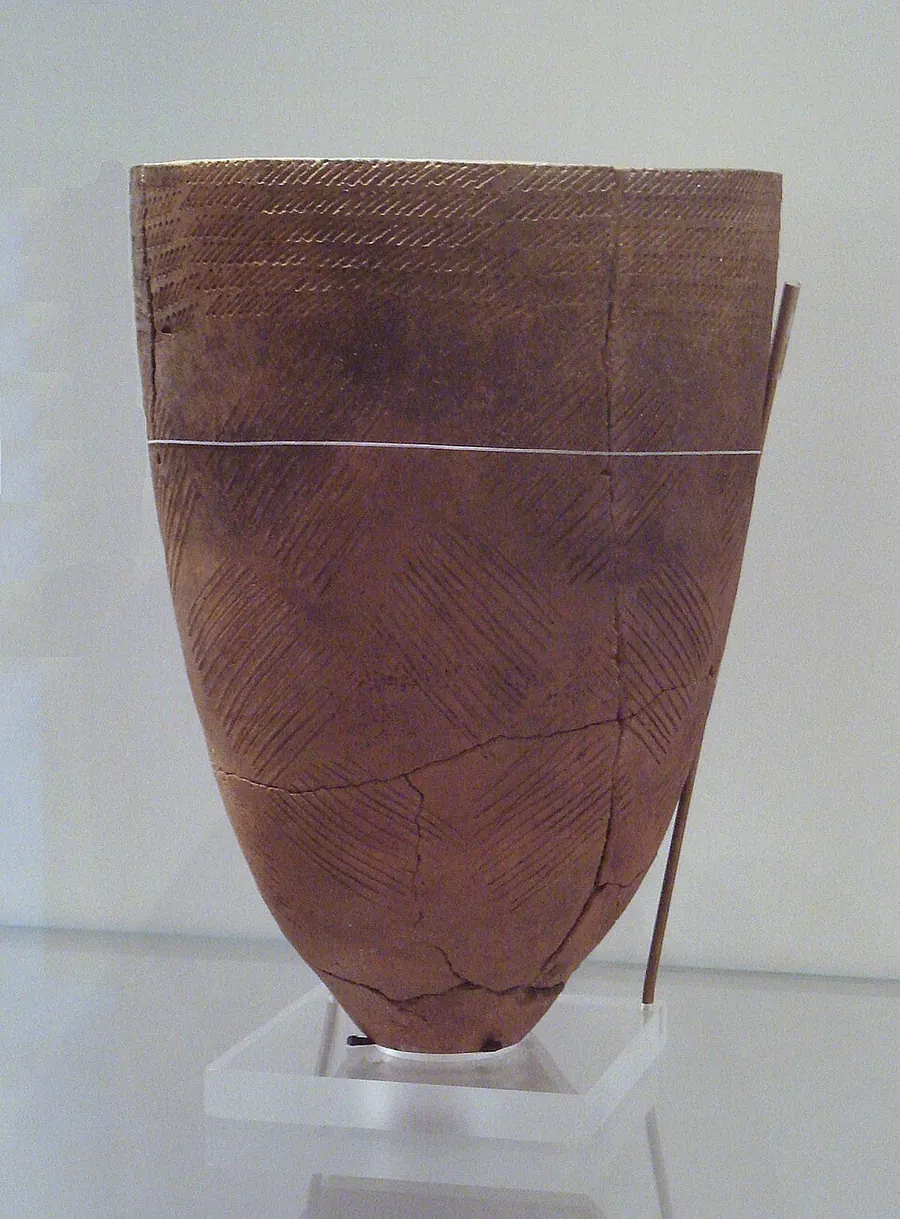
There was a village of Neolithic people on the bank of the Han River at Amsa-dong, Seoul. People lived in pit houses, dug into the ground and covered with a roof. At the house sites, bowls carved with comb-like stripes, stones for hanging on nets, and burnt acorns were found. From these, we can tell that they lived by catching fish and gathering acorns to eat.
More detail
Two sources checked
Why it happened
Amsa-dong in Gangdong-gu, Seoul, is right next to a bend of the Han River. People could catch fish in the river and pick acorns on the hills behind.
Because food could be obtained nearby, Neolithic people built many houses here and lived for a long time.
What happened
People lived in pit-houses, made by digging the ground shallowly in a round or square shape, setting up posts, and covering the roof with grass and branches. In the middle of the house they made a hearth ringed with river stones.
At the house sites, much comb-pattern pottery (bitsalmuneui pottery), with a pointed bottom and comb-like lines incised on the surface, came out. Net sinkers, grinding stones (galdol and galpan) for grinding grain and nuts, and burned acorns also came out together.
It first became known in the great flood of 1925 (the Eulchuk year), when soil on the riverbank was washed away and pottery fragments appeared. It was excavated in earnest in the 1970s.
What came of it
Amsa-dong is one of the places that best shows the appearance of a Neolithic village on the Korean Peninsula. The net sinkers and acorns tell us that fishing and gathering fruits were at the center of life.
It was designated a historic site in 1979 and is now a prehistoric site park with pit-houses reconstructed.
Links with other countries
Pottery of the comb-pattern lineage also appears in many parts of Northeast Asia, such as the Liao River basin in China (the lineage relationship is under debate).