 BETA
EventPrehistory and Gojoseon
Spread of the Bipa-Shaped Bronze Dagger Culture
900–400 BCE (estimated) · Gojoseon · Liaoning region and the Korean Peninsula
Today: Chaoyang area, Liaoning, China, and all of the Korean Peninsula
The bipa-shaped bronze dagger, a bronze sword shaped like the musical instrument bipa (a pear-shaped lute), is a relic that stands for Gojoseon culture.
What happened
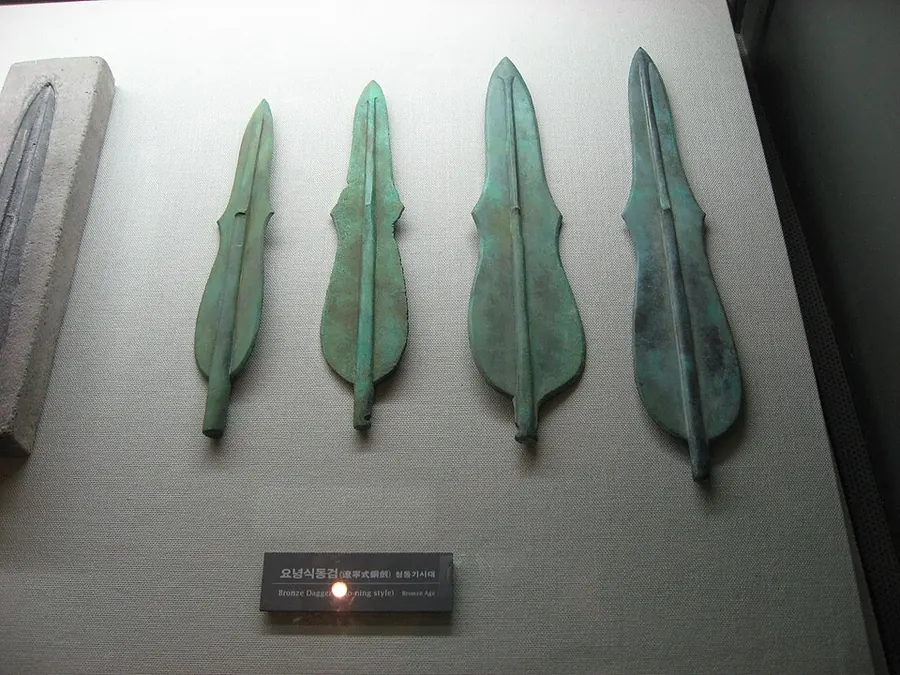
The bipa-shaped bronze dagger is a bronze sword whose blade looks like the musical instrument bipa (a lute). The middle of the blade bulges out, and the blade and the handle were made separately and fitted together. This sword is found in both the Liaoning region and the Korean Peninsula. So it is a clue to how far Gojoseon culture spread.
More detail
Two sources checked
Why it happened
Around 1000 BCE a distinctive Bronze Age culture flourished in the Liaoning region of China. As this culture spread to the Korean peninsula, the bronze dagger that represents it came along too.
What happened
The lower part of the blade swells in a round curve and there are projections on both sides in the middle, so it looks like a bipa, an old stringed instrument (the lute). That is why it is called the bipa-shaped bronze dagger.
It differs from Chinese-style bronze daggers, whose blade and handle were cast in one piece, in that the blade and the handle were made separately and fitted together. On the Korean peninsula it has been found mainly in stone-cist tombs and dolmens, and also in tombs at Songguk-ri in Buyeo.
What came of it
Bipa-shaped bronze daggers are found evenly across Liaoning and the Korean peninsula. So, together with Misongri-type pottery and table-type dolmens, they are used as clues to how far Gojoseon culture spread.
Over time the blade became gradually thinner and straighter, leading to the slender-bladed (Korean-style) bronze dagger found mainly on the Korean peninsula.
Links with other countries
It belongs to the same line as the bronze daggers from the Shi'ertaiyingzi and Nanshangen sites in Liaoning Province, China, so it is also called the Liaoning-style dagger. Some Chinese scholars see this dagger as belonging to another group, the Donghu.