 BETA
EventNorth and South States Period
Rebuilding of Bulguksa Temple and Construction of Seokguram Grotto (Seokbulsa)
c. 751–774 CE · Unified Silla · Bulguksa and Seokbulsa on Mount Tohamsan, Silla
Today: Jinhyeon-dong, Gyeongju, North Gyeongsang Province
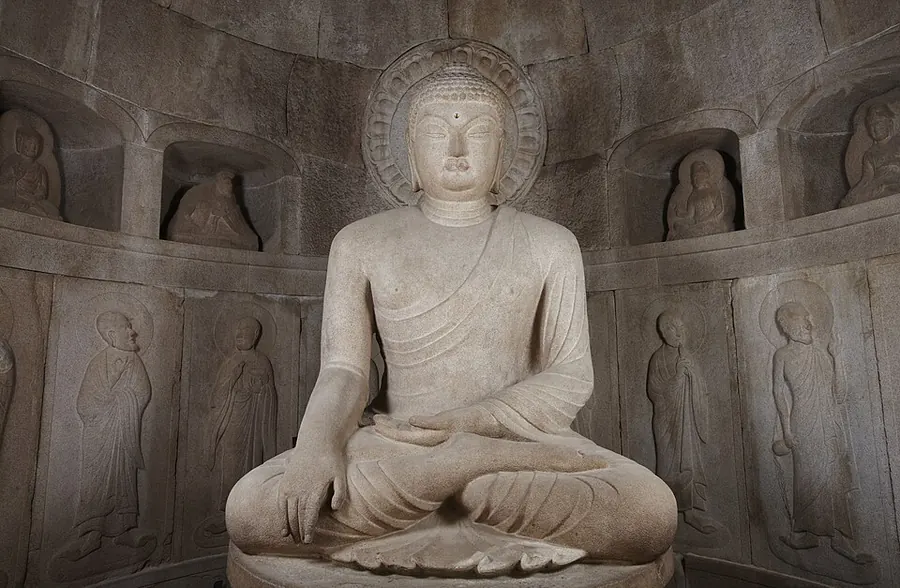
The rebuilding of Bulguksa and the building of Seokbulsa (Seokguram), said to have been started in 751 under Silla's King Gyeongdeok by the chief minister Kim Dae-seong, was finished by the state after his death in 774. It stands as the greatest masterpiece of Silla Buddhist art and became a UNESCO World Heritage Site in 1995.
What happened
Why did the people of Silla build Bulguksa and Seokguram on Mount Toham? The Samguk Yusa says the chief minister Kim Dae-seong built the two temples for his parents. In 751 he rebuilt Bulguksa on a grand scale and began work on Seokguram, and after he died the state took over and finished it. The pagodas Dabotap and Seokgatap and the finely made stone grotto show Silla's skill, and together they became UNESCO World Heritage in 1995. Work done with united hearts over a long time lasts even a thousand years.
More detail
Two sources checked
Why it happened
Why did the people of Silla build a stone chamber on a mountain, along with a great temple? In the mid-8th century, under King Gyeongdeok, Silla was prosperous and Buddhism was in full bloom. People wanted to create a Buddha's land (bulguk-to) on this earth.
The Samguk Yusa says that the chief minister Kim Dae-seong built Bulguksa for his parents in this life and Seokbulsa (today's Seokguram) for his parents from a past life. From Kim Dae-seong's position, this project was a great state undertaking, but it was also a way of carving his feelings for his parents into stone.
What happened
In 751 (the 10th year of King Gyeongdeok) Kim Dae-seong rebuilt Bulguksa, which stood on the western side of Mount Toham, on a grand scale. Higher up the mountain, he began building Seokbulsa, an artificial stone grotto shaped like a round room made of carved and stacked stones. Fitting together hundreds of stones one by one made it a three-dimensional puzzle far harder than any Lego set.
Then came a crisis. When Kim Dae-seong died in 774, the work was still not finished. One person's lifetime was not enough. So the state took over the work and finished it. The main Buddha inside the grotto sits with the fingertips of his right hand pointing to the ground, the pose of driving away demons. The start date of 751 comes from the Samguk Yusa, and some argue, based on a document found in Seokgatap, that work began as early as 742. The completion date is also uncertain.
What came of it
Bulguksa kept its outstanding stone architecture, such as Dabotap, Seokgatap, and the Cheongungyo and Baegungyo bridges. Seokguram, built by fitting hundreds of stones together precisely, shows Silla's skill in mathematics and architecture.
Both sites were added to the UNESCO World Heritage List together in 1995. This stone structure, begun by one person and finished by the whole state, still speaks to people today after more than 1,000 years: big things last when many people join hearts and carry them on.
People in this event
- Kim Daeseong — It is said that he built Bulguksa and Seokguram for his parents.