 BETA
EventNorth and South States Period
Printing of the Mugujeonggwang Great Dharani Sutra
751 CE (estimated) · Unified Silla · Seokgatap Pagoda (three-story stone pagoda) at Bulguksa Temple, Silla
Today: Bulguksa Temple, Jinhyeon-dong, Gyeongju, North Gyeongsang
This Buddhist sutra, found inside Seokgatap Pagoda, is one of the oldest woodblock prints in the world that still exist.
What happened
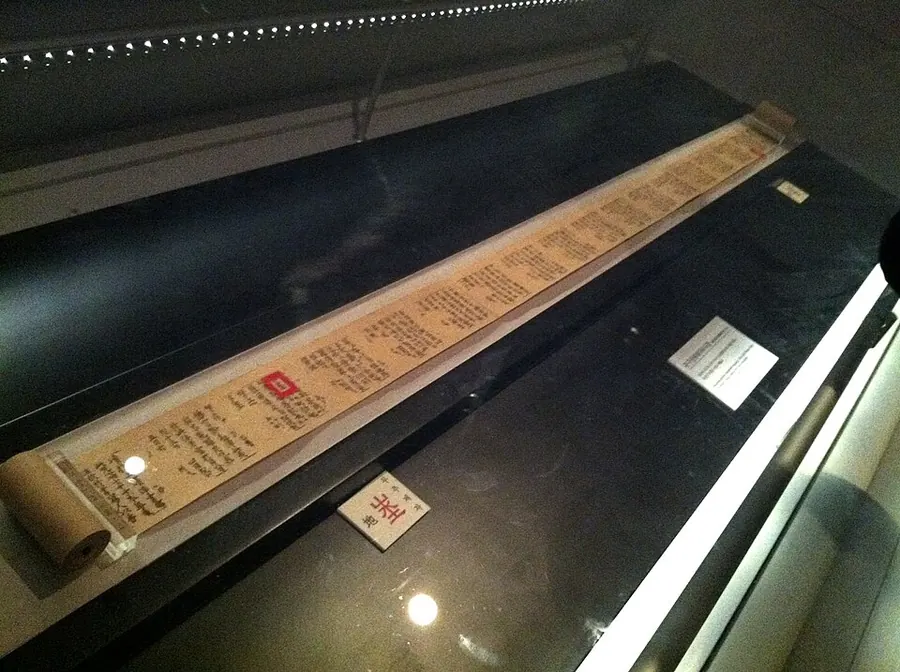
In 1966, while Seokgatap Pagoda at Bulguksa Temple was being repaired, a scroll of Buddhist scripture came out from inside the pagoda. It was printed from characters carved on wooden boards and is one of the oldest prints in the world. It is about 8 cm wide but about 620 cm long, longer than two classroom blackboards joined together.
More detail
Two sources checked
Why it happened
In Buddhism it was believed that placing a scripture called the Mugujeonggwang Dae Dharani Gyeong (Great Dharani Sutra of Pure Light) inside a pagoda brought great blessings and a longer life.
Because many copies of this scripture had to be placed in a pagoda when it was built, instead of copying them by hand, a method of carving the characters on wooden blocks and printing them was used.
What happened
In 1966, while Seokgatap (the three-story stone pagoda) at Bulguksa Temple in Gyeongju was being repaired, a paper scroll was found in a box holding relics inside the body stone of the second story. Its width was about 7 to 8 cm and its unrolled length about 620 cm, longer than two classroom blackboards joined together.
The scripture contains special characters that Empress Wu Zetian of Tang created in the 690s and that were used only briefly. So it is thought to have been printed after 704 and before around 751, when Seokgatap was built.
What came of it
It predates Japan's 'Hyakumanto Darani' (around 770) and is counted as one of the oldest woodblock prints in the world that survive today.
It shows that Silla's papermaking and woodblock carving techniques were excellent. However, some Chinese scholars claim that it was printed in Tang and brought into Silla.
Links with other countries
Use of characters created in the reign of Empress Wu Zetian of Tang; compared with Japan's Hyakumanto Darani (770); the Chinese scholarly view that it was printed in Tang.