 BETA
EventThree Kingdoms Period
The Gyerim-ro Dagger of Gyeongju: A Golden Dagger from the Western Regions
401–500 CE (estimated) · Silla · Geumseong of Silla
Today: Tomb No. 14, Gyerim-ro, Gyeongju, North Gyeongsang Province
In a small tomb in Gyeongju, a golden dagger that seems to have been made far away in Central Asia or around the Black Sea was found.
What happened
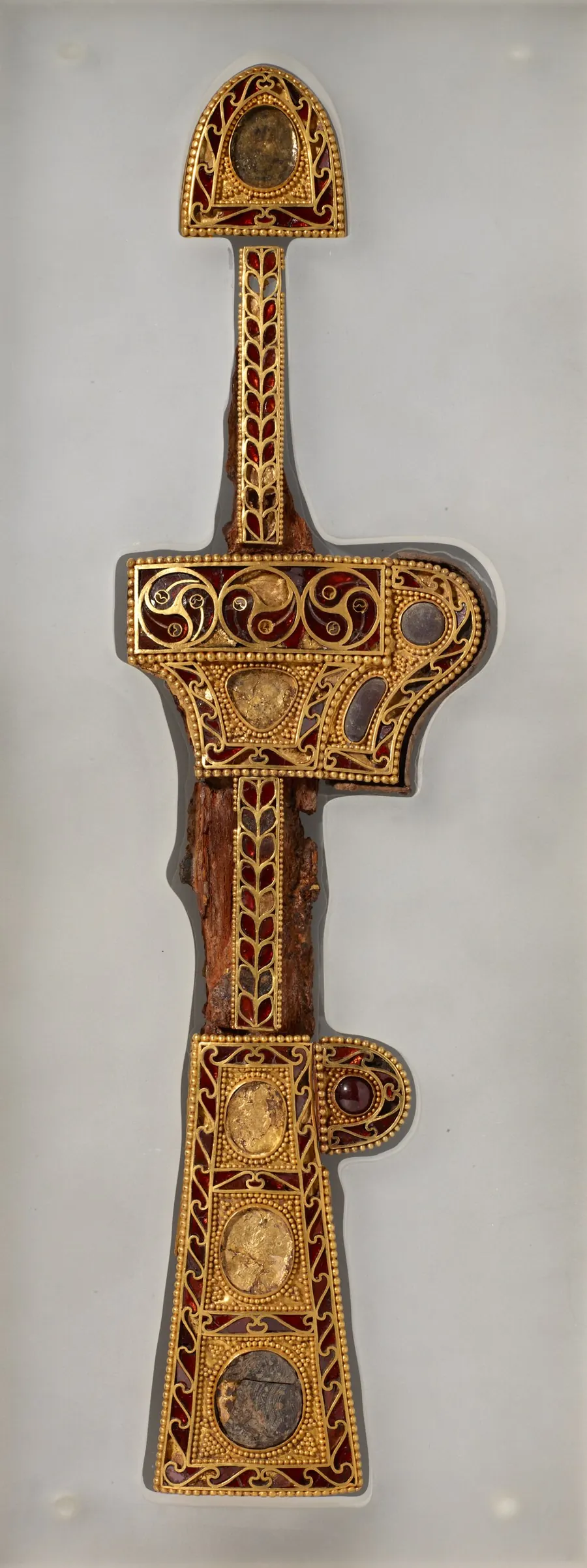
In 1973, a golden dagger 36 cm long was found in a small tomb in Gyeongju. It is a blade decorated with tiny grains of gold and red gems set on a gold plate. This kind of decoration was popular far away in Eastern Europe and the lands to the west. It is proof that Silla was connected to a much wider world than expected.
More detail
Two sources checked
Why it happened
Through the road linking the northern steppe and China, Silla took in goods even from regions very far to the west. That several glass vessels from the Western Regions came out of tombs in Gyeongju is proof of this.
This golden dagger too is thought to have come to Silla along such an exchange route.
What happened
In 1973, small tombs came to light during road-widening work at Gyerim-ro in Gyeongju. From Tomb No. 14 among them, an ornamental dagger 36 cm long was found.
The iron blade and wooden sheath had rotted away, but the gold-plate decoration that had wrapped the sheath and handle remained intact. Patterns were made on the gold plate by attaching very small grains of gold, and red garnets were set into each cell. This decorative technique was popular around the 5th century along the Black Sea coast and in Central Asia.
What came of it
This dagger is evidence that Silla was connected to a much wider world than one might think. Almost no swords of the same shape have come out elsewhere in East Asia.
It is designated a Treasure and is on display at the National Gyeongju Museum.
Links with other countries
The culture of ornamental swords of Central Asia, the Black Sea coast, and Eastern Europe; presumed to have come in via Northern Wei in China