 BETA
EventJoseon Period
Creation and Proclamation of Hunminjeongeum
1443–1446 · Joseon · Hanyang, Gyeongbokgung Palace
Today: Jongno-gu, Seoul, Republic of Korea
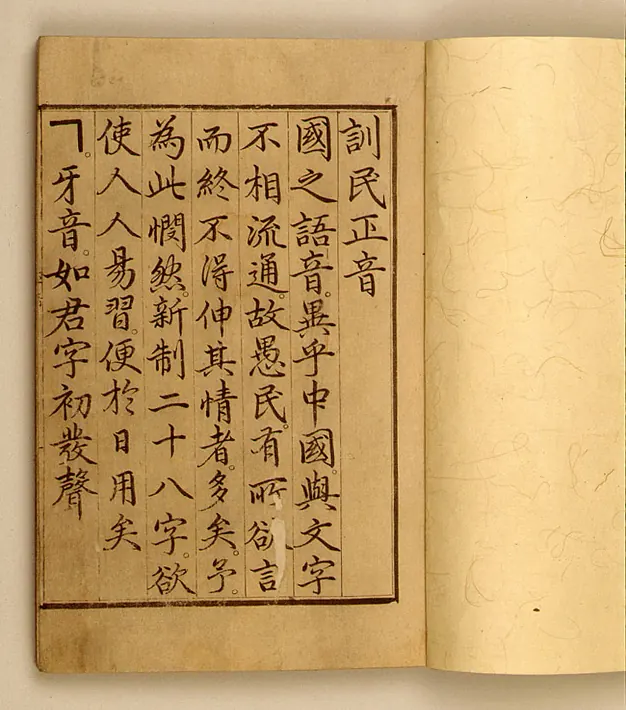
In the 12th lunar month of 1443, King Sejong created Hunminjeongeum (Hangul), an alphabet that ordinary people could learn easily. He explained it with scholars and announced it widely in 1446. Its explanatory edition was discovered in 1940 and became a Memory of the World item.
What happened
Why did Sejong create a new alphabet? Hanja (Chinese characters) were hard, and most ordinary people could not read or write, so Sejong created 28 letters that write the Korean language just as it sounds and announced them in 1446 as Hunminjeongeum. There was opposition, but he left behind the Haerye edition, in which he explained the principles with scholars. It is now a Memory of the World item, and it is the beginning of Hangul, which Koreans use every day.
More detail
Two sources checked
Why it happened
How frustrating would it be to be able to speak but not read?
People in Joseon spoke Korean but wrote in Hanja, the Chinese characters. Hanja has a huge number of characters and is built differently from Korean, so only the yangban (the noble class), who could study for a long time, found it easy to read and write.
Sejong felt sorry for ordinary people who could not even write down their grievances when they were wronged, so he decided to create, by himself, an easy alphabet that could write the Korean language just as it sounds.
What happened
The Sejong Sillok (Annals of King Sejong) entry for the 12th lunar month of 1443 says that Sejong created the "28 letters of Eonmun" and named them Hunminjeongeum. The consonants were modeled on the shapes of the mouth and tongue when making each sound, and the vowels on the heavens (·), the earth (ㅡ) and a person (ㅣ).
But not everyone applauded. In February 1444, Choe Man-ri and others at the Jiphyeonjeon (the Hall of Worthies) submitted a petition objecting that it was wrong to create a script different from China's. Even so, Sejong did not give in.
With eight scholars, including Jeong In-ji, Sin Suk-ju, Seong Sam-mun, Choe Hang, Bak Paeng-nyeon, Gang Hui-an, Yi Gae and Yi Seon-ro, Sejong explained the principles and use of the letters. In the first ten days of the 9th lunar month of 1446, the book containing these explanations, Hunminjeongeum (the Haerye edition), was completed.
What came of it
Hunminjeongeum means "the correct sounds for teaching the people." In the preface, Jeong In-ji wrote that a wise person could learn it in a day, and even a less quick one in ten days. These letters are today's Hangul.
The Haerye edition was forgotten for a long time, then found in 1940 in an old house in Andong, North Gyeongsang Province, where Jeon Hyeong-pil (Gansong) bought it and saved it. It is now a National Treasure, and since 1997 a UNESCO Memory of the World item. Hangul Day, October 9, is the first ten days of the 9th lunar month of 1446 converted to the solar calendar.
When Koreans send a message to a friend or write down their thoughts today, they do it thanks to letters that began in a king's care for his people.
People in this event
- Sejong — He created 28 easy letters for writing Korean and spread them widely.
- Seong Sam-mun — He visited Huang Zan in Liaodong many times to study speech sounds.
- Sin Suk-ju — He studied speech sounds and letters with Seong Sam-mun and helped create the script.
- Jeong In-ji — He compiled the Haerye edition and wrote its preface.
- Gang Hui-an — He took part, with the Hall of Worthies scholars, in explaining Hunminjeongeum.