 BETA
Person
Heo Jun
1539–1615 · Royal physician of Joseon · Joseon
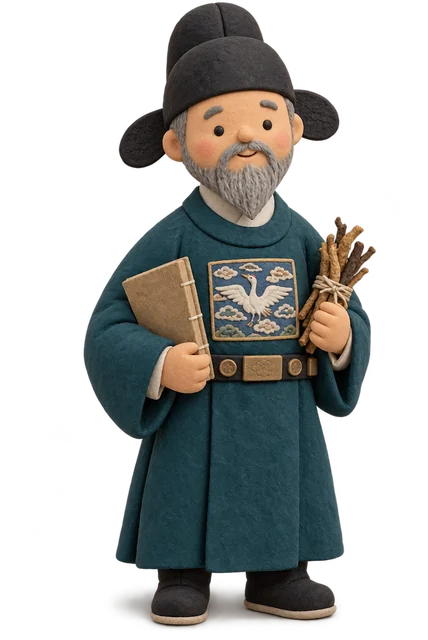
A Joseon physician who overcame discrimination against children of secondary wives (seoja), became the king's royal physician (uiwon), and kept writing even after being driven out, finishing the Dongui Bogam in 1610.
How did a child who faced discrimination become the king's doctor? Heo Jun was a seoja, a son of a secondary wife, but his skill was recognized and he became a palace doctor. During the Imjin War he stayed with King Seonjo all the way as the king fled, and after Seonjo died he was punished and left the palace, but he never stopped writing. In this way he finished the Dongui Bogam in 1610, which is now a Memory of the World treasure.
More detail
Two sources checked
How did a child born into a status that faced discrimination come to write the nation's medical book? Heo Jun was born in 1539 into a military official's family, but because his mother was not a legal wife, he was treated as a seoja and faced discrimination. So he took up the path of a physician, a job the yangban (the noble class) looked down on.
From his youth his skill was well known, and he treated the illnesses of yangban such as the scholar Yu Hui-chun. On Yu Hui-chun's recommendation he came to work at the Naeuiwon, the palace medical office. In 1590 he cured Crown Prince Gwanghae of smallpox and was given a high rank as a reward. Many objected, because the reward went beyond the limit a seoja could normally reach, but King Seonjo did not change his mind.
During the Imjin War in 1592, he stayed at King Seonjo's side as the king fled to Uiju, and for this he was named a merit subject in 1604. In 1596 King Seonjo ordered Heo Jun and several other physicians to compile a new medical book. When the work stopped because of the Jeongyu War, Heo Jun took charge of it alone.
The crisis came in 1608, when King Seonjo died. Heo Jun took responsibility, lost his post and was driven out beyond Seoul. Records differ on the punishment, saying either 'expelled from the capital' or 'exiled to Uiju.' Yet he wrote more than half of the book during this time. He finished the Dongui Bogam in 1610, and it was printed in 1613.
The Dongui Bogam valued preventing illness and caring for the body over just curing it, and it organized how to make good use of medicinal herbs grown in Korea. Heo Jun also published a medical book with Hangul explanations and a book on treating epidemic diseases. The Dongui Bogam was published several times in China and Japan, and in 2009 it became a UNESCO Memory of the World. Heo Jun died in 1615.
Even in a hard situation, Heo Jun finished the work he was given, and his book still passes on the wisdom of caring for our bodies ahead of time.
Life timeline
- 1571Rises to a post in the Naeuiwon
- 1590Cures Gwanghae's smallpox
For this he received a high rank, rare for a seoja. - 1596Begins writing the Donguibogam
- 1604Becomes a Hoseong Gongsin (Meritorious Subject for Escorting the King)
He was recognized for serving the king to the end during the war. - 1608Loses his post for responsibility over Seonjo's death
- 1613Publishes the Donguibogam and issues a book on epidemics