 BETA
Person
Jeong Seon
1676–1759 · A painter of Joseon · Joseon
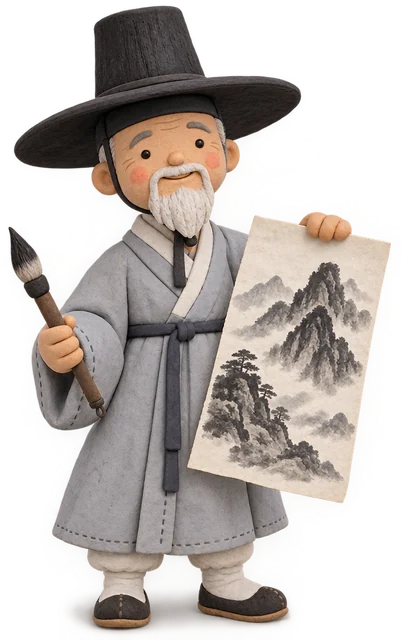
The pioneer of jingyeong sansu-hwa (true-view landscape painting), who painted Korea's mountains and rivers by looking at them directly.
Jeong Seon was a painter who did not copy Chinese paintings but looked directly at Korea's own mountains and rivers and painted them. He gained his name with the paintings he made while traveling through Geumgangsan. His masterpiece is the Inwang Jesaekdo, which paints Inwangsan after the rain stopped.
More detail
Two sources checked
Jeong Seon's pen name was Gyeomjae. He was born in 1676, the eldest son of a yangban family that lived west of Seoul and had long been unable to hold office. He was outstanding in painting from childhood and entered government service with the help of Kim Chang-jip, from a neighboring prominent family.
Until then, landscape painting often depicted scenery from Chinese books or imaginary mountains. Jeong Seon painted the scenery of Korea itself from direct observation, such as the Diamond Mountains, scenic spots on the east coast, ferry crossings along the Han River, and the valley of Inwangsan near his own home. Such paintings are called jingyeong sansuhwa (true-view landscape painting). He also traveled with friends such as the poet Yi Byeong-yeon and left poems and paintings together.
He did not copy what he saw as it was but recomposed it, bringing out its character. His 'Geumgang Jeondo' of 1734 holds the countless peaks of the Diamond Mountains within one great circle, rendering pointed rocky peaks with sharp lines and earthen, tree-covered mountains with soft dots. In 'Inwang Jesaekdo' he expressed the heaviness of wet rocks after rain had cleared by layering dark ink many times.
He also served as magistrate of places such as Cheongha and Hayang. During a little over four years as Magistrate of Yangcheon from the end of 1740, he agreed with his friend Yi Byeong-yeon to exchange poems and paintings, painted scenes along the Han River, and left them as the Gyeonggyo Myeongseungcheop. In 1756 he rose even to a post of junior second rank, rare for a painter.
His style was passed on to later generations of painters such as Kim Hong-do and Choe Buk, forming a current called the 'Gyeomjae school,' and became the main stream of Korean landscape painting until the early nineteenth century.
Life timeline
- 1711Traveled to the Diamond Mountains and painted
- 1729Became Jubu of the Hanseongbu
- 1734Became Cheongha magistrate
That year he painted 'Geumgang Jeondo,' which holds the Diamond Mountains in a great circle. - 1740Became Yangcheon magistrate
He exchanged poems and paintings with Yi Byeong-yeon and painted scenes of the Han River. - 1756Rose to Jipjungchubusa, junior second rank