 BETA
Person
Jeong Yak-yong
1762–1836 · Silhak scholar · Joseon
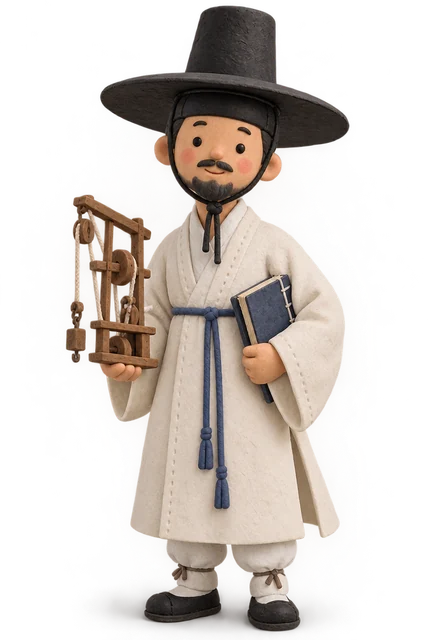
Jeong Yak-yong, born in 1762, built the geojunggi (a lifting crane) for Hwaseong Fortress in Suwon and, in about 18 years of exile in Gangjin from 1801, wrote more than 500 volumes including the Mokmin Simseo, bringing the Silhak (Practical Learning) school together.
What did Jeong Yak-yong do during 18 years of exile? Favored by King Jeongjo, he designed Hwaseong Fortress in Suwon and thought up the geojunggi, but in 1801 he was driven out to Gangjin because of his interest in Catholicism. There he wrote more than 500 volumes, including the Mokmin Simseo, and after being released in 1818 he kept writing back in his hometown. His life shows that if you don't give up even in hard times, that time lasts a long while.
More detail
Two sources checked
Could the darkest time, when the path to office was blocked, turn out to be the most fruitful time? Jeong Yak-yong's pen name was Dasan. He was born into a Namin family in Yanggeun, Gyeonggi Province (today's Namyangju), and around age 16, reading the books of Yi Ik, he opened his eyes to a new learning that could change the country (Silhak).
After passing the civil service examination in 1789, he was favored by King Jeongjo and served as a secret royal inspector, magistrate of Goksan and in other posts. In 1789 he laid a bridge of boats across the Han River (baedari), and in 1793 he designed Hwaseong Fortress in Suwon. At this time he also devised the geojunggi, which uses pulleys to lift heavy stones with little force. It was like a friend in a group project who, instead of everyone struggling to carry a heavy load, first thought of a good tool.
But his interest in Catholicism (Western learning), formed in his youth through his friendship with Yi Byeok and Yi Seung-hun, came back to trouble him. In 1801, during the Sinyu Persecution, he was exiled to Janggi in Gyeongsang Province, and later that year, after the fallout of the Hwang Sa-yeong Silk Letter Incident, he was moved to Gangjin in Jeolla Province. With the king's strong protection gone, crisis came all at once.
Yet the 18 years he spent in Gangjin were dark for a government career but the most fruitful for him as a scholar. He probably filled each day at his desk without giving up. While teaching his students, he wrote the Gyeongse Yupyo (a plan for reforming the state system), the Mokmin Simseo (what a county magistrate should do) and the Heumheum Sinseo (on fair trials), among others. The books he wrote come to more than 500 volumes, and most were written during this time.
After he was released in 1818 at age 57 and returned to his hometown, he continued his research and writing until he died in 1836. His books tell us today that if we don't stop our work even in hard times, that time becomes a lasting gift.
Life timeline
- 1783Passes the jinsa examination
- 1789Passes the civil service examination
That same year he laid a boat bridge across the Han River. - 1793Designs Hwaseong Fortress in Suwon
- 1817Writes the Gyeongse Yupyo
- 1818Released from exile
He returned to his hometown after 18 years.
Related events
- 1784Yi Seung-hun's Baptism and the Founding of the Catholic Church
- 1794Building of Hwaseong Fortress in Suwon
- 1801Sinyu Persecution
- 1818Jeong Yak-yong's Mongmin Simseo